Beginner

Skar Audio
Skar Audio RP-800.1D
Price varies, check the listingA class D monoblock with a bass remote included, which is the usual first subwoofer amplifier.
Check price on AmazonPower calculator
Quick answer
Peak power is a marketing figure and RMS is the measured one. A subwoofer advertised at 1,200 watts max is typically rated somewhere near 300 to 600 watts RMS, and the difference between 300 and 1,200 watts is 6 dB, which is less than it sounds.
Result
Ten decibels is roughly a doubling of perceived loudness, and ten decibels takes ten times the power. This is why the jump from 500 to 1,000 watts is far less dramatic than the numbers suggest.
The formula
dB difference = 10 x log10(P2 / P1)
CTA-2006, formerly CEA-2006, is the published standard: RMS power at 1 percent distortion into a stated impedance at 14.4 volts. A product that quotes a CTA-2006 figure has been measured. A product that quotes only a max or peak number has not told you anything you can use. There is no fixed ratio between the two, so no calculator can convert one into the other, and this one does not pretend to.
The figures above are computed with these exact inputs: Amplifier RMS power 500 W, Compare against 1000 W, Load impedance 2 ohms.
Some of these are published physics or manufacturer figures and some are conventions. They are not the same kind of number, so each one is labeled.
| Assumption | Kind | Where it comes from |
|---|---|---|
| CTA-2006 (formerly CEA-2006) | Published figure | CTA-2006 (formerly CEA-2006), the mobile amplifier power measurement standard: RMS power at 1 percent THD+N into a stated impedance at 14.4 volts |
| SPL = sensitivity + 10 x log10(power) | Published figure | SPL = sensitivity + 10 x log10(power), the logarithmic power relation |
Every card below is in the page source. The calculator re-ranks them against your numbers and marks anything that falls short of what you just calculated.
A class D monoblock with a bass remote included, which is the usual first subwoofer amplifier.
Check price on Amazon
A thousand watt class D monoblock at the budget end of the range.
Check price on Amazon
A published 1,000 watt RMS figure rather than a peak number, in a compact chassis.
Check price on Amazon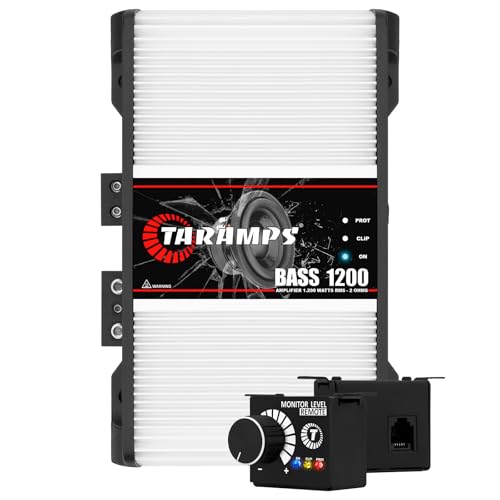
A published 1,200 watt RMS at 1 ohm, which is the load most dual 2 ohm subwoofers end up at.
Check price on Amazon
A 1 ohm stable monoblock with a published RMS rating and a crossover on board.
Check price on Amazon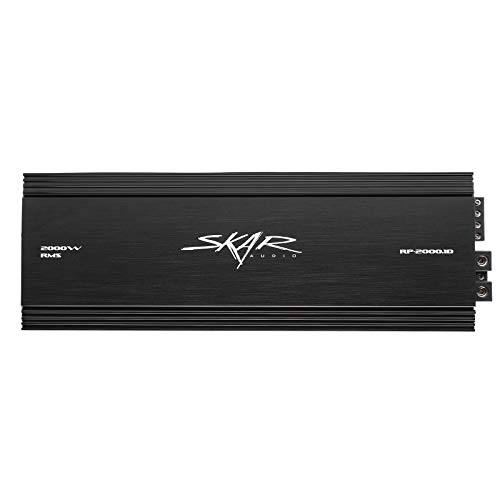
Two thousand watts needs a charging system upgrade first. Buying this before the big 3 is the wrong order.
Check price on AmazonResearched guidance, not professional advice. These results are planning figures from published relations and manufacturer specifications. Fit the main fuse within 18 inches of the battery positive terminal, because that fuse protects the wire and the wire is what starts a fire. Disconnect the battery before running power wire, use a grommet through every piece of sheet metal, and remember that sustained high sound pressure causes permanent hearing damage.