Subwoofers
One 12 Inch vs Two 10 Inch Subwoofers: Which Setup Wins?
Researched from published physics, alignment relations and manufacturer specifications. Updated .
Quick answer
The one-big-driver-versus-two-smaller-drivers question comes up constantly, and the honest answer starts with cone area rather than nominal diameter. A 12 inch label describes the frame size, not the moving surface that actually pushes air, and once the comparison is made on effective cone area rather than the number printed on the driver, two 10 inch subwoofers turn out to move more air than one 12 inch subwoofer, even though a 12 sounds like the bigger number.
That does not automatically make two 10s the right call. Two drivers mean two mounting cutouts, a larger combined box, and a wiring scheme that has to keep the amplifier's load in a safe range, while one 12 is a simpler build that still gets most of the way there. This comparison walks through the cone area math, the mutual coupling gain from running two identical drivers together, and where the extra box volume and install complexity change the answer.
Do two 10s really move more air than one 12?
On representative cone area figures, yes. A 10 inch driver has an effective cone area of roughly 56.7 square inches, so two of them together total about 113.4 square inches, compared to roughly 81.7 square inches for a single 12 inch driver. Those are conventional, representative figures for effective radiating area rather than a spec pulled from any one driver, and the actual Sd for a given model is published on its own data sheet and can vary from these numbers. Even accounting for that variance, two 10s generally out-total one 12 on combined cone area.
There is a second effect worth knowing: when two identical drivers share the same signal and sit close together in a common or coupled enclosure, they gain roughly 3 dB from mutual coupling on top of whatever their combined cone area and power handling would predict on their own. That gain assumes matched drivers wired and mounted the way the design intends, not two mismatched subwoofers thrown into a box together.
Head to head
| Factor | One 12 Inch | Two 10 Inch |
|---|---|---|
| Effective cone area (representative) | About 81.7 sq in | About 113.4 sq in combined |
| Mutual coupling gain | Not applicable | Up to about 3 dB when matched |
| Box volume needed | Smaller, single driver | Larger, two drivers |
| Mounting cutouts | One | Two |
| Wiring complexity | Single voice coil set | Two drivers to match in series or parallel |
| Amp load flexibility | Fewer wiring options | More wiring options with dual voice coils |
Convention Source: Effective cone area figures are representative industry conventions; the exact Sd for any driver is on its own manufacturer spec sheet.. Mutual coupling gain applies to matched, identically wired drivers sharing a common signal, not to mismatched pairs.
Matching matters more than the driver count
Two 10s should be the same model, same impedance, and wired to see a matched load. Pairing two different subwoofers, even two drivers of the same nominal size from different product lines, means different Thiele-Small parameters, different power handling, and different behavior in the same box volume. The subwoofer wiring calculator works out series and parallel options for a given voice coil configuration so the amplifier sees a safe combined impedance, and it should be run before wiring is finalized, not after the drivers are already mounted.
The real cost of two 10s: box volume
Cone area is not the only number that changes with driver count. Two 10 inch subwoofers generally need a combined net volume that is larger than what a single 12 inch driver requires, and depending on the specific drivers chosen, that combined volume can approach what a single, larger 15 inch driver would need on its own. The manufacturer's per-driver recommended volume, multiplied by two and adjusted for any shared internal bracing, is the number to build to, not a guess based on the 12 inch box the setup is replacing.
This is where a lot of two-10 builds run into trouble: the cone area and coupling gain look appealing on paper, but the vehicle's available space was sized around a single 12 inch box, and two 10s in a properly built enclosure simply do not fit the same footprint. Running the sealed box volume calculator or ported box volume calculator for the actual drivers chosen, before assuming the swap is a drop-in, avoids that surprise.
Power and amplifier matching
Two 10 inch subwoofers typically split the amplifier's power between them rather than each receiving the same power a single 12 inch driver would get on its own amplifier channel, unless the amplifier and wiring are sized specifically to feed both drivers at their full individual rating. Dual voice coil 10 inch drivers give more wiring flexibility, series, parallel, or a series-parallel combination across two drivers, which can be used to hit a target impedance the amplifier is comfortable driving. Check the amplifier's rated power at the resulting impedance, not just its headline power figure, before assuming two drivers will each get full power.
Who should buy which
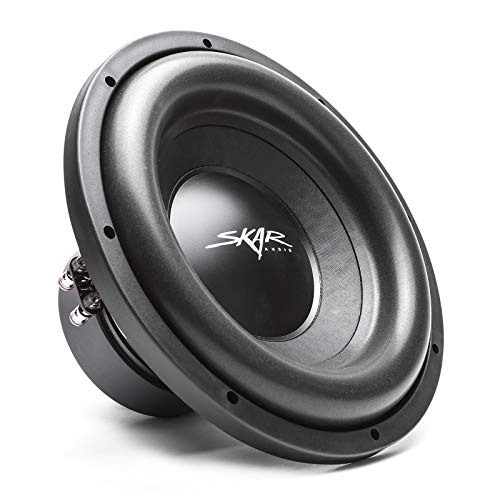
Skar Audio SDR-12 D4
Price varies, check the listingA straightforward single 12 inch driver for a simpler build with one mounting cutout and one box to size, when total install simplicity matters more than the last few percent of cone area.
Check price on Amazon
CT Sounds Bio 10 D2
$69.99A 10 inch driver suited to a matched pair, giving the combined cone area and mutual coupling advantage of a two-10 build when two identical units are used.
Check price on Amazon
Pioneer TS-A25S4
$64.81Another 10 inch option for a matched two-driver setup in a system where a shallower individual driver depth helps the combined box fit the available space.
Check price on Amazon
QPower dual 10 slot ported
$64.99A ported enclosure built around two 10 inch drivers, sized for the combined volume a matched pair actually needs rather than a box designed for a single driver.
Check price on AmazonFrequently asked questions
- Do two 10 inch subwoofers hit harder than one 12 inch subwoofer?
- On combined cone area, two matched 10s generally total more effective radiating surface than one 12, roughly 113 versus 82 square inches by representative figures, and can add up to about 3 dB more from mutual coupling when wired and mounted correctly. The tradeoff is a larger combined box and two mounting cutouts instead of one.
- Can I mix a 10 inch and a 12 inch subwoofer in the same box?
- It is not recommended. Different drivers have different Thiele-Small parameters, power handling, and ideal box volumes, so a shared enclosure sized correctly for one driver will not be correct for the other, and the shared airspace can work against both. Matched, identical drivers are what make the combined cone area and mutual coupling numbers in this comparison hold true.
- How much bigger does the box need to be for two 10s versus one 12?
- It depends on the specific drivers, but two 10 inch subwoofers commonly need a combined net volume larger than a single 12 inch driver's recommendation, sometimes approaching what one 15 inch driver would need. Check each driver's own manufacturer spec sheet and add the two volumes together rather than estimating.
- Does running two 10s instead of one 12 need a bigger amplifier?
- Not necessarily a bigger amplifier, but it does change the wiring and the impedance the amplifier sees. Two dual voice coil 10 inch drivers can be wired several ways to land on a target impedance, and the amplifier's rated power at that specific impedance is what determines how much power each driver actually gets.
- What is mutual coupling and does it really add output?
- Mutual coupling is the acoustic gain from two identical drivers sharing a signal and operating close together in a common space, and it can add roughly 3 dB beyond what the drivers would produce independently. It requires matched drivers wired and mounted as the coupling effect assumes, not two different subwoofers placed near each other.
Researched guidance, not professional advice. The cone area and coupling figures here are representative conventions for planning purposes, not a substitute for the Thiele-Small parameters and recommended enclosure volume published for the exact drivers being installed. Confirm both before committing to a box design.