Enclosures
Understanding Thiele/Small Parameters for Subwoofer Boxes
Researched from published physics, alignment relations and manufacturer specifications. Updated .
Quick answer
Thiele/Small parameters, usually shortened to T/S parameters, are a set of published measurements that describe how a bare subwoofer driver behaves electrically and mechanically. They come from the manufacturer's spec sheet, not from guesswork, and they are the actual inputs to the equations that determine sealed box volume, vented box volume, and tuning frequency. Understanding what each parameter physically represents makes it possible to read a spec sheet and predict, in broad terms, whether a given driver wants a small sealed box, a large vented one, or something in between.
This guide covers the parameters that matter most for enclosure design: Fs, Vas, Qts, Qms, Qes, Xmax, and Sd, followed by the sealed box equations and the QB3 vented alignment equations that use them.
What do these letters actually mean?
Fs is the driver's free-air resonant frequency in Hz, the frequency at which the moving mass and the suspension's springiness naturally want to oscillate when the driver is not mounted in any enclosure. Vas is the equivalent compliance volume, expressed in cubic feet or liters: it is the volume of air that would have the same springiness as the driver's own suspension, which is a way of expressing how stiff or how loose the suspension is in terms everyone can compare across different drivers. Qts is the total Q at resonance, a single number combining Qms, the mechanical Q from the suspension's friction and stiffness, and Qes, the electrical Q from the voice coil and magnet's damping effect. Xmax is the linear one-way excursion in millimeters, the distance the cone can travel from rest in one direction while still moving linearly and accurately. Sd is the effective cone area, and it is smaller than the driver's nominal size suggests because it excludes the surround and only counts the area that actually moves air.
| Parameter | Meaning | Units |
|---|---|---|
| Fs | Free-air resonant frequency | Hz |
| Vas | Equivalent compliance volume | cubic feet or liters |
| Qts | Total Q at resonance (Qms + Qes) | unitless |
| Xmax | Linear one-way excursion | mm |
| Sd | Effective cone area | square inches or cm2 |
Published figure Source: Published on manufacturer subwoofer spec sheets.
Sealed box math from T/S parameters
For a sealed box, the target enclosure volume and the resulting system resonance both come directly from Vas, Fs, and the chosen Qts alignment, called Qtc. The equations are Vb = Vas / ((Qtc/Qts)^2 - 1) for the box volume, and Fc = Fs x (Qtc/Qts) for the resulting system resonance in that box. Qtc of 0.707 is the maximally flat alignment, meaning the frequency response rolls off without a peak or an early dip, and it is the most commonly targeted value for a general-purpose sealed subwoofer box. A higher Qtc trades a small response peak near resonance for a smaller box, while a lower Qtc trades a larger box for a gentler, earlier roll-off.
Vented QB3 alignment
For a vented box using the QB3 alignment, the equations are Vb = 20 x Vas x Qts^3.3 for box volume, Fb = 0.42 x Fs x Qts^-0.96 for the tuning frequency, and F3 = 0.26 x Fs x Qts^-1.4 for the resulting low-frequency roll-off point. These equations are published and standard, but they only describe a useful, well-behaved vented alignment over roughly a Qts range of 0.2 to 0.5. Outside that range the resulting box either becomes impractically large and the tuning too low to be useful, or the alignment stops behaving like a clean vented response at all.
When Qts says sealed instead of vented
A Qts above about 0.5 generally wants a sealed box, not a vented one. The QB3 vented alignment produces sensible box sizes and tuning frequencies mainly in the Qts 0.2 to 0.5 range. A driver with a higher Qts, often one designed with a looser suspension for sealed applications, tends to produce an unrealistically large or poorly behaved vented box under the QB3 formulas, while the sealed box equations continue to produce a reasonable, well-controlled result at higher Qts values.
Where to find these numbers for a real driver
Thiele/Small parameters are published on the manufacturer's product page or spec sheet for a specific driver model, not estimated from the driver's nominal size or price point. Two subwoofers marketed as the same size can have meaningfully different Fs, Vas, and Qts figures depending on their motor design and suspension, which is exactly why a box built for one driver is not automatically correct for another, even one that looks similar on the outside.
Putting it together: from spec sheet to box
In practice, a spec sheet gives Fs, Vas, and Qts, and those three numbers alone are enough to compute either a sealed box volume and resulting resonance, or, if Qts falls in the right range, a vented box volume, tuning frequency, and roll-off point. Xmax and Sd matter for a different question, which is how loud the driver can play cleanly before running out of linear travel, and they do not change the box volume calculation but do matter when pairing a driver with an amplifier and deciding how hard to drive it.
What you need
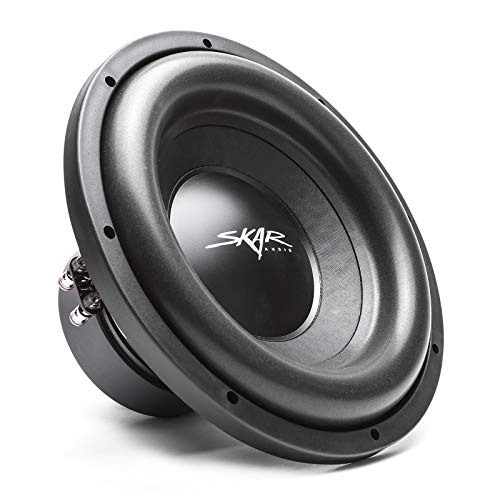
Skar Audio SDR-12 D4
Price varies, check the listingA widely available 12 inch subwoofer with published T/S parameters, useful as a reference point for working through the sealed and vented equations.
Check price on Amazon
CT Sounds Tropo 12 D4
$129.99Another 12 inch option with its own published Fs, Vas, and Qts figures for comparing how different drivers change the resulting box design.
Check price on Amazon
Kicker Comp 10
$89.88A 10 inch driver for anyone designing a smaller enclosure, showing how the same equations scale down with a smaller Vas.
Check price on AmazonFrequently asked questions
- What is Qts and why does it matter most for box design?
- Qts is the total Q of the driver at resonance, combining the mechanical damping from the suspension and the electrical damping from the voice coil and magnet. It is the single parameter most often used to decide whether a driver suits a sealed box or a vented one, since the QB3 vented equations only behave sensibly over roughly a 0.2 to 0.5 Qts range.
- Can I use the QB3 formula for any subwoofer?
- Not reliably outside a Qts of roughly 0.2 to 0.5. Within that range the QB3 equations produce a sensible box volume and tuning frequency. Above about 0.5, the formulas tend to call for an impractically large box or produce a poorly behaved alignment, and a sealed box design using the same driver's Vas and Fs is usually the better fit.
- What counts as a good Qts for a ported box?
- Roughly 0.2 to 0.5 is the range where the QB3 vented alignment produces a practical box size and a clean roll-off, with values in the middle of that range generally giving the most balanced result between box size, tuning frequency, and output extension. Outside that window, a sealed design built from the same driver's Vas and Fs tends to behave far more predictably.
- Do all subwoofer manufacturers publish Thiele/Small parameters?
- Most reputable manufacturers publish Fs, Vas, Qts, Xmax, and Sd on the product spec sheet, since these numbers are what box-building software and calculators need. If a specific driver's spec sheet does not list them, that driver should not be used as the basis for a calculated box design without contacting the manufacturer for the figures.
- What is Xmax used for if not for box volume?
- Xmax describes how far the cone can move linearly in one direction before distortion rises sharply, which relates to how much clean output the driver can produce, not to enclosure volume. It matters when matching power and expected excursion to the driver, separate from the Vas and Qts figures used in the volume equations.
- Is Vas the same thing as the recommended box volume?
- No. Vas is the volume of air that has the same springiness as the driver's own suspension, and it is an input to the box volume equations, not the answer itself. The actual recommended sealed or vented box volume comes from plugging Vas, Fs, and Qts into the sealed or QB3 equations.
Researched guidance, not professional advice. Always use the published Thiele/Small parameters for the exact driver model being installed, since even similar-looking subwoofers from the same manufacturer can carry meaningfully different figures.