Subwoofers
What Size Subwoofer Should You Buy?
Researched from published physics, alignment relations and manufacturer specifications. Updated .
Quick answer
Subwoofer shopping usually starts and ends with diameter: 8, 10, 12, or 15 inches. Diameter is an easy number to compare, but it is not the number that determines output. Cone area, the surface that actually pushes air, scales faster than diameter, and it is possible for two smaller drivers to outperform one larger one on total area while taking a similar amount of space.
This guide compares effective cone area across common sizes, lays out the box volume each size typically needs, and walks through how vehicle space, not a preference for a bigger number, should usually be the deciding factor.
Does a bigger diameter always mean more output?
Not directly. Output scales with cone area, which grows faster than diameter because area is a function of radius squared. Going from a 10-inch to a 12-inch driver looks like a 20 percent increase in size, but the actual increase in moving surface is closer to 44 percent, which is a meaningfully bigger jump than the diameter number suggests on its own.
This is also why comparing two drivers of the same nominal size can be misleading. Two 12-inch subwoofers from different manufacturers can have different actual cone areas because the surround width eats into the usable diameter differently between designs, which is part of why a spec sheet's actual Sd figure matters more than the marketed size.
Excursion, meaning how far the cone can move forward and back, is the other half of the output equation alongside cone area, and it does not track neatly with nominal size either. A smaller driver with generous excursion can move more air on some bass notes than a larger driver with a shallower motor design, particularly at lower tuning frequencies where cone travel matters more than surface area alone. Checking excursion figures alongside cone area on a spec sheet gives a fuller picture than diameter or Sd by themselves.
How does cone area compare across common subwoofer sizes?
| Nominal size | Approx. cone area (Sd) | Two-driver total |
|---|---|---|
| 8-inch | ~35.3 sq in | ~70.6 sq in |
| 10-inch | ~56.7 sq in | ~113.4 sq in |
| 12-inch | ~81.7 sq in | ~163.4 sq in |
| 15-inch | ~132.7 sq in | ~265.4 sq in |
Convention Source: Representative estimate; real Sd is listed on each driver's own spec sheet. Two 10-inch drivers total roughly 113 square inches of cone area, more than a single 12-inch driver's roughly 82 square inches, which is why paired smaller subwoofers can outperform one larger one.
How much box volume does each size actually need?
Box volume, not cone area, is usually the real limit on subwoofer size in a typical vehicle. As a general convention, an 8-inch sealed enclosure needs roughly 0.3 to 0.6 cubic feet per driver, a 10-inch needs 0.6 to 1.0, a 12-inch needs 1.0 to 1.75, and a 15-inch needs 1.75 to 3.0. These are typical net volume ranges, not a substitute for the specific driver's recommended enclosure spec.
Two 10s or one 12: which is the better choice?
Two matched 10-inch subwoofers give more total cone area than a single 12, at roughly 113 versus 82 square inches, and each driver typically needs less individual box volume, which can make packaging easier in some trunks even though the combined box is larger overall. The tradeoff is more complexity: two voice coils to wire, a larger overall footprint even if each cavity is smaller, and in some cases a higher total cost for two drivers and a bigger amplifier to power them both properly.
A single well-chosen 12 is the simpler build. It is one enclosure, one set of wiring, and usually one channel of amplification is easier to size correctly for. For most daily-driver builds where simplicity matters, one strong 12-inch subwoofer is the more practical choice, and the case for two smaller drivers gets stronger specifically when maximizing output in a fixed budget or fixed amplifier channel count is the goal.
Impedance also plays into this decision. Two dual-voice-coil 10-inch subwoofers open up more wiring configuration options for reaching a given final impedance than a single dual-voice-coil 12, since there are simply more voice coils available to arrange in series or parallel. That flexibility can matter when trying to land on a specific impedance that a chosen amplifier is most efficient or most stable driving, and it is worth checking against the subwoofer wiring calculator before finalizing either a one-driver or two-driver plan.
How does vehicle space actually limit the decision?
Trunk depth, spare tire wells, and rear seat folding mechanisms all eat into usable enclosure volume before a single cubic foot number gets applied. A sedan trunk that looks spacious by eye can still fall short of a 15-inch driver's minimum recommended volume once the enclosure has to clear the rear deck and leave room for the spare. Measuring the actual available space, not just eyeballing it, before choosing a size prevents ordering a subwoofer that never fits a box that meets its spec.
Running the target driver's Thiele-Small parameters through the sealed box volume calculator or the ported box volume calculator before buying confirms whether the space on hand can actually house it.
What you need to size a subwoofer correctly
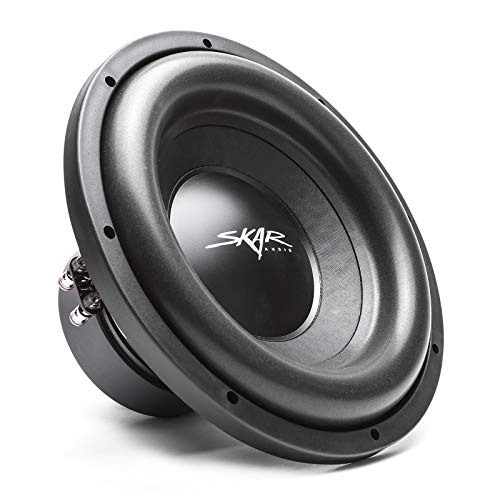
Skar Audio SDR-12 D4
Price varies, check the listingA 12-inch dual-voice-coil subwoofer is the common middle ground: strong cone area without an oversized box requirement.
Check price on Amazon
Pioneer TS-A250D4
$99.98A 10-inch option fits tighter trunks or pairs well as a matched set for more total cone area in the same overall footprint.
Check price on Amazon
Goldwood TR12S sealed 12
$48.99A pre-built sealed enclosure sized correctly for a 12-inch driver removes the guesswork of building a box to spec.
Check price on AmazonCommon mistakes when choosing subwoofer size
The most common mistake is picking a size based on diameter alone and assuming bigger always means louder, when box volume and vehicle space are usually the real constraints. A second is borrowing a box volume from a different driver of the same nominal size, since two 12-inch subwoofers from different brands can call for different enclosure volumes based on their individual Thiele-Small parameters, not just their diameter.
A third mistake is choosing a 15-inch driver for a hatchback or sedan without first measuring the actual trunk space, which often results in an enclosure that has to be undersized relative to spec just to fit, hurting output and sometimes damaging the driver under heavy excursion. Measuring first and matching the box to the specific driver's spec sheet, not a size-based guess, avoids all three.
A fourth mistake worth flagging is choosing shallow-mount subwoofers purely for the space savings without checking their typical output ceiling relative to standard-depth drivers of the same nominal size. Shallow subwoofers solve a genuine packaging problem, particularly under truck seats or in tight hatchback floors, but they often trade some cone excursion for that reduced depth, which can mean less output at the same power compared to a standard-depth driver of the same diameter. Choosing a shallow mount because the space genuinely requires it is reasonable; choosing one purely out of habit when a standard-depth driver would fit is leaving output on the table for no reason.
Frequently asked questions
- Is a bigger subwoofer always louder than a smaller one?
- Not automatically. Output depends on cone area and how well the enclosure matches the driver's specs, not diameter alone. A well-matched smaller subwoofer in a correctly sized box can outperform a larger one crammed into an undersized enclosure, since box volume mismatches hurt output more than a modest size difference does.
- Are two 10-inch subwoofers better than one 12-inch subwoofer?
- Two 10-inch subwoofers have more combined cone area, roughly 113 square inches versus about 82 for a single 12, so they can produce more total output. The tradeoff is more wiring complexity, more amplifier channels or a bigger amplifier, and typically a larger overall footprint, so it comes down to available space and budget rather than a universal answer.
- How much box volume does a 12-inch subwoofer need?
- As a general convention, roughly 1.0 to 1.75 cubic feet of net sealed volume per driver, though the exact figure depends on the specific subwoofer's Thiele-Small parameters. Always check the manufacturer's recommended enclosure volume for the exact model rather than relying on a size-based estimate alone, since two drivers of the same nominal size can call for noticeably different volumes.
- Can I use the same box for two different 12-inch subwoofers?
- Not safely without checking specs. Two 12-inch subwoofers from different manufacturers can have different Thiele-Small parameters and different recommended volumes, so a box sized for one may be too small or too large for another, which affects both output and how the driver behaves under excursion, especially near the bottom of its usable frequency range.
- What subwoofer size fits a small sedan trunk?
- An 8 or 10-inch subwoofer usually fits a small sedan trunk more comfortably, needing roughly 0.3 to 1.0 cubic feet of net volume per driver depending on size. A 12 or 15-inch driver can still work if the trunk is measured carefully first, but tight trunks often cannot house the larger recommended enclosure without compromising volume.
- Does cone area or power matter more for output?
- Both matter, but cone area is frequently the cheaper way to gain output since SPL only rises 3 dB per doubling of power. A larger cone area, whether from a bigger single driver or a matched pair, can deliver a comparable output gain to a much larger and more expensive amplifier upgrade.
Researched guidance, not professional advice. Cone area figures here are representative estimates, and every driver's actual Sd and recommended enclosure volume are on its own spec sheet. Confirm the exact numbers for the specific subwoofer before cutting or buying a box.