Enclosures
Port Length for 3 Cubic Feet Tuned to 35 Hz
Researched from published physics, alignment relations and manufacturer specifications. Updated .
Quick answer
A ported enclosure is a Helmholtz resonator: the air in the port is a mass and the air in the box is a spring. Tuning is set by three things and only three things, which are the net box volume, the port area and the port length. Fix any two and the third is decided for you.
This page fixes the volume at 3 cubic feet and the tuning at 35 Hz, and gives the length for every sensible port size. Change either number for your own build with the port length calculator, and remember that the volume to use is the net volume the driver sees, not the gross internal volume of the box.
How long does a round port need to be for 3 cubic feet at 35 Hz?
Every length below tunes the same 3 cubic feet to the same 35 Hz. They differ only in port area, and area is what decides whether the port makes noise.
| Port | Area | Length |
|---|---|---|
| 2 inch round | 3.1 sq in | 1.48 in |
| 3 inch round | 7.1 sq in | 3.95 in |
| 4 inch round | 12.6 sq in | 7.57 in |
| 5 inch round | 19.6 sq in | 12.34 in |
| 6 inch round | 28.3 sq in | 18.27 in |
Published figure Source: The Helmholtz resonator relation, in the form commonly published for vented loudspeaker enclosures: Lv = (1.463e7 x R^2) / (Fb^2 x Vb) minus the end correction. Calculated with a single flanged end, the usual case for a port flush with an outside panel. A port with both ends in free air is slightly longer and a fully flared port is slightly shorter.
What about a slot port?
A slot port is solved the same way. Convert the rectangle to a round port of equal area and the relation is identical. The one thing to remember is that a wall of the box counts as a wall of the port, which is what makes slot ports so much easier to build.
| Slot | Area | Length |
|---|---|---|
| 12 x 2 in slot | 24 sq in | 15.32 in |
| 12 x 2.5 in slot | 30 sq in | 19.46 in |
| 14 x 2 in slot | 28 sq in | 18.08 in |
| 10 x 3 in slot | 30 sq in | 19.46 in |
Published figure Source: The Helmholtz resonator relation, in the form commonly published for vented loudspeaker enclosures: Lv = (1.463e7 x R^2) / (Fb^2 x Vb) minus the end correction. A slot port folded along a box wall displaces volume from the box it tunes, and that displacement has to be added back or the finished box ends up smaller than the figure it was designed around.
How much port area does this box need?
The most repeated answer is 12 to 16 square inches of port per cubic foot, which for 3 cubic feet works out at about 37.5 square inches. That figure is a convention. It is a reasonable starting point and it is not a measurement.
The defensible version of the question is air velocity. Peak air speed through the port is the cone area multiplied by excursion and by two pi times the tuning frequency, divided by the port area. Above roughly 17 metres per second, port noise generally becomes audible, and that threshold itself depends on how well the port ends are flared. The slot port calculator works it out from your driver's cone area and Xmax.
The practical consequence is a trade you cannot escape: more port area means less port noise and a longer port, and at some point the port will not physically fit inside the box it is tuning. That is a real constraint, and the usual answers are a lower tuning, a bigger box, or an aeroport with flared ends.
Where to put the port
Port placement matters less than people expect for tuning and more than people expect for noise. Keep the inside end of the port at least its own diameter away from any panel, or the port is effectively restricted and tunes higher than the calculation says. Flare or round over both ends if you can, because most port noise comes from turbulence at the ends rather than along the length.
Firing the port in the same direction as the driver is the simplest and most predictable arrangement. Firing it into a corner or against a seat back changes both the effective length and the perceived output, and it is the most common reason a finished box measures differently from its design.
Boxes and drivers for this alignment
If you are buying rather than building, the number to look for on a listing is the stated internal volume. A box that does not state its volume cannot be checked against this page, or against your driver's specification.
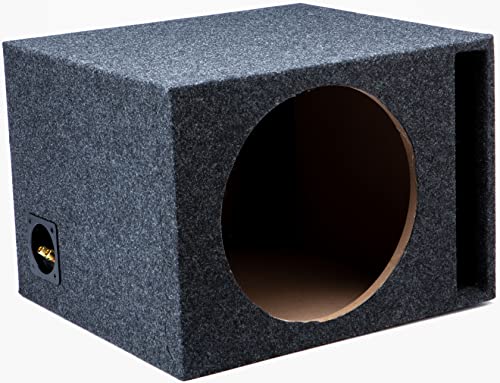
ASC single 12 ported box
$54.95A plain 5/8 inch MDF vented box, which is the cheapest starting point if you are not building your own.
Check price on Amazon
Maxxlink MBXP-112
$54.99A universal fit vented 12 box with UV treated carpet, aimed at a hatch or trunk install.
Check price on Amazon
QPower HD112VL side ported
$77.49A side ported design, which packages into a trunk corner better than a front ported box of the same volume.
Check price on AmazonSubwoofers with published parameters for a ported build

CT Sounds Tropo 12 D4
$129.99A dual 4 ohm 12 that wires to 8 or 2 ohms with one driver, which keeps the amplifier choice open.
Check price on Amazon
Orion Cobalt CBW124D
$74.95The cheapest dual 4 ohm 12 in this catalog from a brand that has published specifications.
Check price on Amazon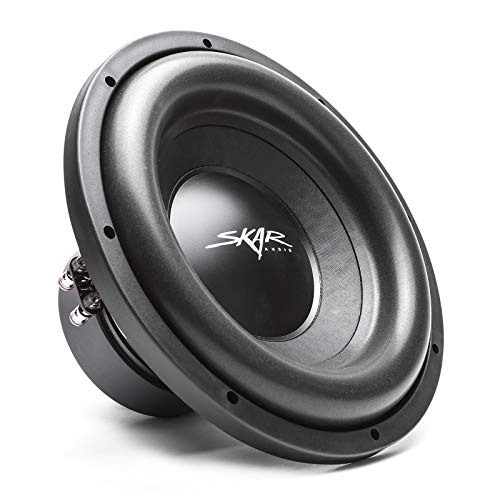
Skar Audio SDR-12 D4
Price varies, check the listingA 2.5 inch four layer coil and a published 22 Hz to 300 Hz response, which is the usual first real subwoofer.
Check price on Amazon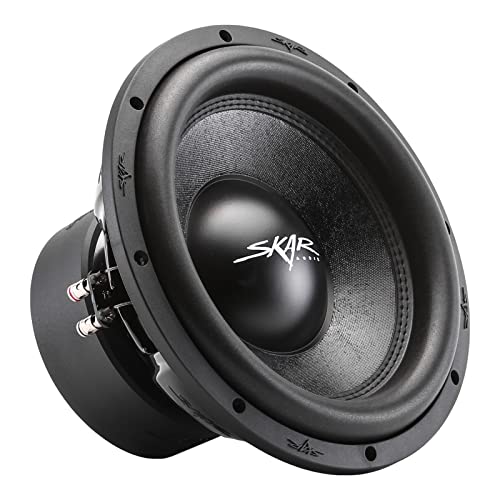
Skar Audio SVR-12 D4
Price varies, check the listingA step up in motor and excursion from the SDR at the same coil configuration, so an existing box often still suits it.
Check price on AmazonFrequently asked questions
- How long should a 4 inch port be for 3 cubic feet at 35 Hz?
- About 7.57 inches, measured as the full length of the port tube including any part inside the box. That figure comes from the Helmholtz relation with a single flanged end. If the port is fully inside the box with both ends in free air it needs to be slightly longer, and a heavily flared aeroport is slightly shorter for the same tuning.
- Does port length change if I use two ports instead of one?
- Yes, and by more than people expect. Two ports of the same diameter have twice the area of one, and port length rises with area, so each of the two ports has to be considerably longer than the single port would have been. Work out the total area you want first, then solve for the length of that total area rather than sizing each port on its own.
- Do I use gross or net volume when calculating port length?
- Net volume, meaning the air the driver actually sees after the driver, the port and any bracing have been subtracted. Using gross internal volume makes the port come out too short, which tunes the box higher than intended. There is a circularity here, because the port displacement depends on the port length: start with an estimate, calculate, then recalculate with the real port displacement.
- What is a subsonic filter and do I need one at 35 Hz tuning?
- A subsonic filter is a high pass filter set just below the box tuning frequency, so for a 35 Hz box it usually sits somewhere between 27 and 32 Hz. It is needed on any ported box. Below tuning the port stops loading the cone, excursion rises very quickly for very little output, and a driver can be damaged by content you cannot even hear.
- Why does a bigger port need to be so much longer?
- Because length scales with the square of the port radius in the Helmholtz relation, while area scales with the square of the radius too. Doubling the diameter quadruples the area and roughly quadruples the length needed for the same tuning. That is why large ports in small boxes quickly become physically impossible and why slot ports folded along a wall are so common.
Build it to the driver, not to a rule of thumb. The only enclosure volume that governs is the one the driver manufacturer publishes for that exact model. A box that is meaningfully too small raises the system Q and can drive a subwoofer past its excursion limit at frequencies it should handle easily, and a ported box that is too large or tuned too low unloads the cone below tuning. If your driver does not publish a recommended volume, use its Thiele/Small parameters in the calculators rather than a figure taken from a driver of the same nominal size.