Reference
Port Area and Velocity Chart: The 12.5 Rule and the Physics Behind It
Researched from published physics, alignment relations and manufacturer specifications. Updated .
Quick answer
Ported box design leans on two very different kinds of numbers, and mixing them up leads to a lot of confused advice online. The first kind is a rule of thumb: some number of square inches of port area for every cubic foot of net box volume, most often quoted as 12.5, that experienced builders use as a fast starting point before they check anything else. The second kind is actual physics: the velocity of air moving through that port opening, which depends on the driver's cone area and excursion, the tuning frequency, and the port's cross-sectional area, and which can be calculated exactly rather than estimated.
This chart lays out both side by side so the rule of thumb has something real to check itself against. Use the port length calculator or slot port calculator to run your own driver's numbers once you have picked a starting port area, and the ported box volume calculator to confirm net volume before either one.
How much port area does a box actually need, by volume?
The 12 to 16 square inch per cubic foot range is a widely repeated design convention with no formal measurement standard behind it. It exists because it produces reasonable port velocities across a wide range of typical driver and tuning combinations, not because any organization tested and published it as a rule.
| Net volume (cu ft) | Minimum (12 sq in/cu ft) | Typical (12.5 sq in/cu ft) | Maximum (16 sq in/cu ft) |
|---|---|---|---|
| 1.0 | 12.0 sq in | 12.5 sq in | 16.0 sq in |
| 1.5 | 18.0 sq in | 18.75 sq in | 24.0 sq in |
| 2.0 | 24.0 sq in | 25.0 sq in | 32.0 sq in |
| 2.5 | 30.0 sq in | 31.25 sq in | 40.0 sq in |
| 3.0 | 36.0 sq in | 37.5 sq in | 48.0 sq in |
| 4.0 | 48.0 sq in | 50.0 sq in | 64.0 sq in |
| 5.0 | 60.0 sq in | 62.5 sq in | 80.0 sq in |
Convention Source: Widely used enclosure design convention, 12 to 16 square inches of port area per cubic foot of net volume. No standards body publishes this figure. It is a starting point for the actual velocity check below, not a substitute for it.
How fast is the air actually moving in that port?
Peak port air velocity depends on the driver's effective piston area (Sd), its one-way excursion (Xmax), the tuning frequency (Fb), and the port's own cross-sectional area. The example below uses a 12 inch driver with an 81.7 square inch Sd (0.0527 square meters) and a 12 millimeter one-way Xmax, in a 3 cubic foot net box tuned to 35 Hz, and varies only the port area to show how directly it controls velocity.
| Port area (sq in) | Peak air velocity (m/s) | Versus the ~17 m/s convention limit |
|---|---|---|
| 12 | 17.97 | Above the limit; port noise likely |
| 16 | 13.48 | Below the limit |
| 20 | 10.78 | Below the limit |
| 24 | 8.98 | Below the limit |
| 32 | 6.74 | Below the limit |
| 40 | 5.39 | Below the limit |
| 50 | 4.31 | Below the limit |
Published figure Source: Peak port velocity = (Sd in m2 x Xmax in m x 2 x pi x Fb) / port area in m2. The 12 square inch row is the same figure the design convention table above suggests for a 3 cubic foot box at its minimum ratio, which is why builders who push power often go past the 12.5 default.
Port length for that same box, three end conditions
Port area and port length are linked: for a fixed tuning frequency and net volume, a wider port needs to be longer to hold that same tuning. The Helmholtz relation below also depends on how the port ends are finished, since a flared or flanged opening changes the effective end correction.
| Port diameter | Radius | Both ends free (in) | One end flanged (in) | Both ends flanged (in) |
|---|---|---|---|---|
| 2 in | 1 in | 1.6 | 1.5 | 0.6 |
| 3 in | 1.5 in | 4.1 | 3.9 | 2.6 |
| 4 in | 2 in | 7.8 | 7.6 | 5.8 |
| 6 in | 3 in | 18.5 | 18.3 | 15.6 |
Published figure Source: Lv = (1.463e7 x R^2) / (Fb^2 x Vb) - k x R, with Vb in cubic inches and R in inches. k is 0.732 with both ends free, 0.823 with one flanged end, and about 1.7 with both ends flanged. Vb is net internal volume after driver and port displacement, not gross box volume.
Why velocity, not area alone, is the real limit
The 12 to 16 square inch convention works for a lot of builds because it happens to land in a reasonable velocity range for typical driver sizes, typical excursion figures, and typical tuning frequencies. But the convention has no way to account for a driver with an unusually large Xmax, a box tuned unusually low, or a build running enough power that excursion at the tuning frequency is much higher than a modest daily-driver setup. In any of those cases, a port sized by the rule of thumb alone can still run past a comfortable air velocity, which shows up as a rushing, chuffing, or whistling noise from the port under hard bass notes.
Working the actual velocity formula backward is the more reliable method: start from the driver's real Sd and Xmax, pick a tuning frequency, and size the port area so peak velocity stays under a comfortable limit at the power level you actually plan to run. That is exactly what the port length calculator and slot port calculator do, and it is worth running even when the 12.5 convention already gives you a plausible-looking number, because plausible and correct are not the same thing on a build pushing real power.
The 17 meters per second limit is a convention too
The commonly cited 17 meter per second port velocity limit, roughly 5 percent of the speed of sound, is a widely used guideline, not a hard physical threshold. The actual point where port noise becomes audible depends heavily on port geometry, particularly whether the port opening is flared or has sharp, unflared edges, since a well-flared port can often run noticeably faster before noise becomes noticeable than a plain cut opening of the same area.
Gear for this
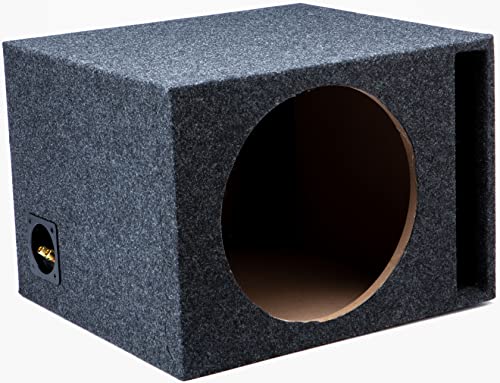
ASC single 12 ported box
$54.95A pre-built ported enclosure sized around a specific port area and tuning takes the port math off the table for builders who would rather not cut MDF.
Check price on Amazon
QPower QBOMB12VL
$96.99A compact ported box with a factory-tuned port lets you compare a known port area and length against the physics in this chart before building a custom box.
Check price on Amazon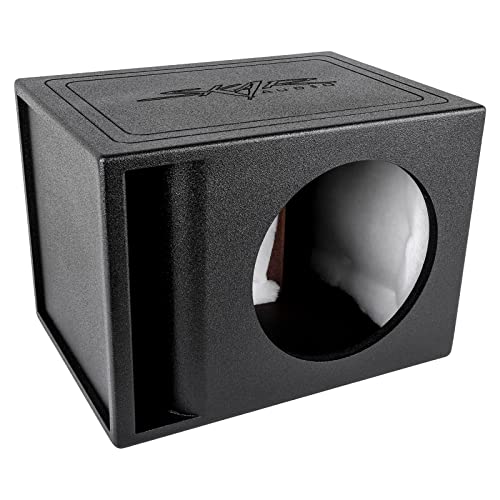
Skar AR1X12V kerf ported
Price varies, check the listingA slot-ported enclosure design that pairs well with the slot port calculator when you want to verify the built-in port's velocity at your actual power level.
Check price on AmazonFrequently asked questions
- Is 12.5 square inches of port per cubic foot a hard rule?
- No, it is a widely repeated design convention with no formal standard behind it. It works reasonably well across many typical driver and tuning combinations, which is why it persists, but it does not account for unusually large excursion, unusually low tuning, or high power levels, all of which can push actual port velocity past a comfortable range even when the area matches the convention.
- What happens if port area is too small for the power going into the box?
- Air moving through an undersized port speeds up, and past a certain velocity that airflow becomes turbulent and audible as chuffing, rushing, or whistling noise, especially on hard, low-frequency bass notes. The port itself is not usually damaged, but the noise is often mistaken for a driver or box problem when the real issue is simply insufficient port area for the power level.
- Does port length matter more than port area for chuffing noise?
- Port area is what directly controls air velocity for a given airflow, so it is the primary factor in chuffing noise. Port length only enters the picture because it has to change along with area to hold the same tuning frequency; a longer port at the same area does not by itself change velocity, but changing area without adjusting length changes the tuning.
- How is peak port velocity calculated?
- Peak velocity equals the driver's effective piston area in square meters, times its one-way excursion in meters, times two pi times the tuning frequency in hertz, divided by the port's cross-sectional area in square meters. Every input comes from the driver's spec sheet and the box design, which is why it is a calculation rather than a rule of thumb.
- Do flared or flanged port ends change the length needed?
- Yes. The Helmholtz port length formula includes an end correction factor that differs by finish: about 0.732 for two free, unflanged ends, 0.823 for one flanged end, and roughly 1.7 for both ends flanged. A flanged or flared port needs to be shorter than a plain cut port tuned to the same frequency in the same box.
- Can two round ports work as well as one slot port?
- Yes, as long as their combined cross-sectional area and total length match what a single port would need for the target tuning; velocity depends on total area, not on whether that area comes from one opening or several. Multiple smaller ports are sometimes used simply because they fit an enclosure's dimensions better than one large port would.
Researched guidance, not professional advice. Port noise itself is not a safety hazard the way clipping or a mismatched amp load can be, but it is a reliable sign the port is undersized for the power actually reaching the box. Recheck the velocity math at your real power level before assuming a louder amp swap will not need a bigger port.