Spec sheets
Rockville W15K9D2 Specifications and Enclosure Notes
Researched from published physics, alignment relations and manufacturer specifications. Updated .
Quick answer
This page collects what is actually published about the Rockville W15K9D2 and says plainly what is not. The full listing title is "Rockville W15K9D2 15" Car Audio Subwoofer, Dual 2-Ohm, 1250W RMS CEA Rated".
The most important thing a subwoofer specification sheet gives you is the set of Thiele/Small parameters and the manufacturer's recommended enclosure volume. Where those are published, use them. Where they are not, which is common at the budget end of the market, the honest position is that no figure taken from a driver of the same nominal size is a substitute, and the sealed and ported calculators need your driver's own numbers to produce a real answer.
Published specifications
Everything below is copied from what the manufacturer publishes. Nothing is inferred.
| Specification | Value |
|---|---|
| Brand | Rockville |
| Nominal size | 15 inch |
| Voice coil | Dual voice coil |
| Impedance per coil | 2 ohms |
| Published RMS power | 1,250 W |
| Thiele/Small parameters | Not published in the listing, check the manufacturer specification sheet |
| Recommended enclosure volume | Not published in the listing, check the manufacturer specification sheet |
Published figure Source: Manufacturer published specifications as they appear in the product listing. Where a row says a figure is not published, that is the honest state of the listing rather than an omission here. A recommended enclosure volume invented from the nominal size is the single most damaging mistake in a subwoofer build.
How do you wire the Rockville W15K9D2?
On its own, this driver presents the loads below. Combining several of them opens up more options.
| Configuration | Final load |
|---|---|
| 2 coils in parallel | 1 ohm |
| 2 coils in series | 4 ohms |
Published figure Source: Ohm's law and the series and parallel resistance relations.
What enclosure does it need?
The honest answer is that the manufacturer's own figure governs, and where it is not published in the listing you should find the specification sheet before building anything. As a planning range only, 15 inch drivers typically want 1.75 to 3 cubic feet sealed or 3 to 5 cubic feet ported tuned around 28 to 33 Hz. That range is a convention across many drivers of this size and it is not a specification for this one.
Drivers of the same nominal size genuinely differ by a factor of two, because enclosure volume follows Vas and Qts rather than diameter. See box volume for one 15 inch driver for the full working.
Cone area and port sizing for this size
Effective cone area is what sets the port area a vented box needs, and it is smaller than the nominal size suggests.
| Figure | Value |
|---|---|
| Nominal size | 15 inch |
| Representative effective diameter | 13 in |
| Representative cone area, Sd | 132.7 sq in |
| Port area the convention suggests, per cubic foot | 12.5 sq in |
Convention Source: Representative effective diameters by nominal size. The real Sd is on the driver specification sheet and varies with surround width. Use the driver's own published Sd when sizing a port properly, because surround width changes it by an inch of effective diameter or more between drivers of this nominal size.
What to pair it with
Match the amplifier to the load the driver presents, not to the maximum power figure on the box. Then size the wire and the fuse to the amplifier's real current draw, which is the part of the build that gets skipped and the part that determines whether the system holds voltage when the bass hits.

Skar Audio RP-800.1D
Price varies, check the listingA class D monoblock with a bass remote included, which is the usual first subwoofer amplifier.
Check price on Amazon
Skar Audio SA-1000.1D
Price varies, check the listingA thousand watt class D monoblock at the budget end of the range.
Check price on Amazon
Rock Direct true 4 gauge kit
$23.99A true 4 gauge kit at under twenty five dollars, with the conductor material stated.
Check price on AmazonOther 15 inch options

Skar Audio SDR-15 D2
Price varies, check the listingThe cheapest way into 15 inches of cone area from a brand that publishes parameters.
Check price on Amazon Skar Audio SDR-15 D4
Price varies, check the listingThe dual 4 ohm version of the same driver, for a two driver build on one amplifier.
Check price on Amazon
Rockville W15K9D2
$159.95One of the few drivers in this catalog with a CEA rated RMS figure rather than only a peak number.
Check price on Amazon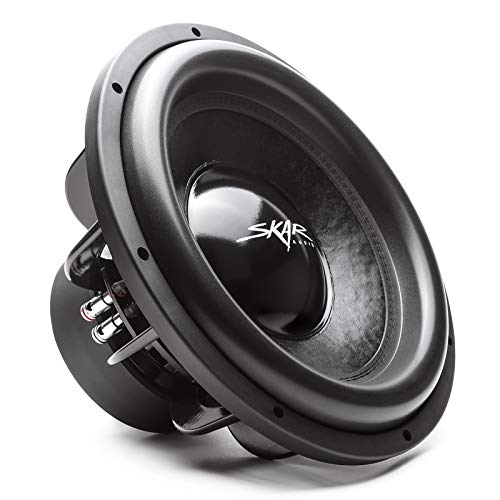
Skar Audio EVL-15 D4
Price varies, check the listingHigh excursion in the largest common size, which means a big box and a charging system to match.
Check price on AmazonFrequently asked questions
- What size box does the Rockville W15K9D2 need?
- Use the manufacturer's published recommendation for this exact model. As a planning range only, 15 inch drivers usually want 1.75 to 3 cubic feet sealed or 3 to 5 cubic feet ported. That range is a convention across many drivers rather than a figure for this one, and building to a number borrowed from a different driver of the same size is how subwoofers get ruined.
- What ohm load does the Rockville W15K9D2 present?
- On its own it presents 1 ohm or 4 ohms, depending on how the two coils are combined. Note that it never presents 2 ohms, despite being named for that figure: the name refers to one coil. Running more than one of these drivers opens up further options, which the wiring calculator will enumerate.
- How much power should I give the Rockville W15K9D2?
- The manufacturer publishes 1,250 watts RMS, and that is the figure to match an amplifier to. A published RMS rating is measured; a maximum or peak figure is not, and there is no fixed ratio between the two. Matching an amplifier to the peak number would give the driver several times the power it is rated to handle continuously.
- Is a sealed or ported box better for this driver?
- Both work for most drivers, and the choice depends on what you want. Sealed is smaller, flatter, far more forgiving of a volume error and better for music with detailed low frequency content. Ported is louder for the same power over a narrower band, needs a bigger box plus a port that physically fits, and requires a subsonic filter below tuning.
- What else do I need besides the driver?
- An enclosure built to the manufacturer's volume, an amplifier matched to the load rather than to the peak power figure, power wire sized for the amplifier's real current draw, a main fuse within 18 inches of the battery, a ground of the same gauge as the power wire, and speaker wire heavy enough for the impedance you are running. The wiring is where most first builds fall short.
Build it to the driver, not to a rule of thumb. The only enclosure volume that governs is the one the driver manufacturer publishes for that exact model. A box that is meaningfully too small raises the system Q and can drive a subwoofer past its excursion limit at frequencies it should handle easily, and a ported box that is too large or tuned too low unloads the cone below tuning. If your driver does not publish a recommended volume, use its Thiele/Small parameters in the calculators rather than a figure taken from a driver of the same nominal size.