Reference
Cone Area by Driver Size: Sd Chart for 8, 10, 12 and 15 Inch Subwoofers
Researched from published physics, alignment relations and manufacturer specifications. Updated .
Quick answer
The number printed on a subwoofer box, 8, 10, 12, or 15 inch, describes the basket, the metal frame the driver bolts into, not the part of the driver that actually moves air. The cone itself sits inside that basket with a surround around its edge, and the surround eats a real amount of that nominal dimension before you get to the part that pistons back and forth. That remaining active area is called Sd, the effective piston area, and it is what actually determines how much air a driver moves at a given excursion, not the number on the box.
Because surround width varies from driver to driver, even at the same nominal size, Sd is never a fixed number for "a 12 inch sub" the way it might seem. This chart uses representative effective diameters to make the comparison possible, and labels them clearly as a convention rather than a measured constant. Always confirm the real Sd, and the Thiele-Small parameters that go with it, on the specific driver's own spec sheet before using it to size a box with the sealed box volume calculator or ported box volume calculator.
What is the actual radiating cone area behind a nominal driver size?
The figures below use representative effective piston diameters commonly seen across mainstream drivers of each nominal size, then apply the standard circle area formula to get Sd. They are a starting estimate, not a substitute for a real spec sheet.
| Nominal size | Effective diameter (convention) | Sd = pi x (d/2)^2 |
|---|---|---|
| 8 in | 6.7 in | 35.3 sq in |
| 10 in | 8.5 in | 56.7 sq in |
| 12 in | 10.2 in | 81.7 sq in |
| 15 in | 13.0 in | 132.7 sq in |
Convention Source: Representative effective piston diameter values applied to the standard circle area formula. Nominal size describes the basket, not the cone. The driver's own spec sheet is the authority whenever it publishes Sd directly.
How much does Sd vary between two drivers of the same nominal size?
Surround width is not standardized across brands, so two subwoofers both labeled 12 inch can have meaningfully different real Sd. The range below shows what happens if effective diameter shifts half an inch in either direction from the representative value above.
| Nominal size | Low estimate (Sd) | High estimate (Sd) |
|---|---|---|
| 8 in | 30.2 sq in | 40.7 sq in |
| 10 in | 50.3 sq in | 63.6 sq in |
| 12 in | 73.9 sq in | 89.9 sq in |
| 15 in | 122.7 sq in | 143.1 sq in |
Convention Source: pi x (d/2)^2 with the representative diameter shifted plus or minus 0.5 inches. A single inch of surround width difference between two 12 inch drivers can shift Sd by more than 10 square inches, enough to matter for excursion and output comparisons.
Combined cone area for multiple drivers
Cone area adds directly when drivers run on the same signal, which is what makes multiple smaller drivers competitive with, or ahead of, a single larger one. The table below sums the representative Sd values from the first table for one through four drivers of each size.
| Nominal size | 1 driver | 2 drivers | 3 drivers | 4 drivers |
|---|---|---|---|---|
| 8 in | 35.3 | 70.6 | 105.9 | 141.2 |
| 10 in | 56.7 | 113.4 | 170.1 | 226.8 |
| 12 in | 81.7 | 163.4 | 245.1 | 326.8 |
| 15 in | 132.7 | 265.4 | 398.1 | 530.8 |
Convention Source: Sum of single-driver Sd values from the representative diameter table above, in square inches. Two 10s (113.4 sq in) already pass one 12 (81.7 sq in). Three 10s (170.1 sq in) pass one 15 (132.7 sq in), which is the whole case for multi-driver builds over a single larger driver.
Why cone area matters beyond bragging rights
More Sd at the same excursion means more air displaced per stroke, and more air displaced per stroke is a large part of what turns into SPL at a given power level. That is why a comparison between one 12 and two 10s is not just a curiosity: at equal power per driver, two 10s with 113.4 combined square inches of Sd are doing more physical work moving air than a single 12 with 81.7 square inches, even before factoring in the acoustic summation gain multiple drivers add on top of that. The SPL calculator and the SPL vs power chart both build on this same idea from the power side of the equation, since a driver's Sd feeds directly into how much SPL a given amount of cone movement can produce.
The tradeoff is box volume and mounting depth. Two 10 inch drivers each need their own enclosure volume, own cutout, and own share of available mounting surface, and two smaller cutouts are not always easier to fit into a given vehicle than one larger one. Two drivers also mean two voice coils to wire, which brings the wiring impedance chart back into the decision, since the final amplifier load with two drivers depends on how their coils and the drivers themselves are combined. Compare specific driver options on the best subwoofers pages and the compare tool once you have decided how much total Sd a build actually needs.
It is also worth remembering that Sd is only one input among several that determine how a driver actually performs in a box. Thiele-Small parameters like Vas, Qts, and Fs interact with Sd to set the correct enclosure volume and tuning, so two drivers with identical Sd but different Qts or Vas figures can still need very different boxes. Sd alone tells you how much air a driver can move at a given excursion; it does not by itself tell you what box that driver wants, which is why the manufacturer's full parameter set, not just Sd, belongs in any real box design.
Nominal size is marketing; Sd is physics
Treat the effective diameters on this chart as a starting estimate, never as a substitute for the manufacturer's published Thiele-Small parameters. Two subwoofers sold under the same nominal size can have Sd values that differ by 10 square inches or more once actual surround width is accounted for, which is enough to change a box volume calculation meaningfully.
Gear for this

Pioneer TS-A250D4
$99.98A widely stocked 10 inch driver that makes a clean example for comparing two-driver combined Sd against a single larger subwoofer.
Check price on Amazon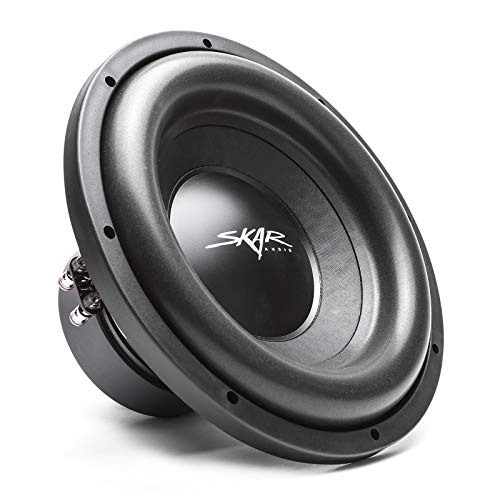
Skar Audio SDR-12 D4
Price varies, check the listingA well-documented 12 inch driver with a published spec sheet, useful as the baseline single-driver comparison point on this chart.
Check price on Amazon
Skar Audio SDR-15 D4
Price varies, check the listingA 15 inch driver for builders weighing maximum single-driver Sd against a multi-driver setup in the same total box footprint.
Check price on AmazonFrequently asked questions
- Does nominal driver size tell you the actual cone area?
- Not precisely. Nominal size describes the basket, the outer frame dimension, while the actual radiating area, called Sd, is smaller once the surround around the cone's edge is subtracted. Two drivers labeled the same nominal size can have different real Sd depending on how wide each one's surround is, so the nominal number is a starting point, not a spec.
- Why do two 10 inch subwoofers sometimes outperform one 12?
- Two 10 inch drivers have roughly 113.4 square inches of combined cone area against about 81.7 square inches for a single 12, so at equal excursion and power per driver, the pair simply moves more air. Multiple drivers on the same signal also add an acoustic summation gain on top of that extra displaced air.
- Where can I find a driver's real Sd value?
- The manufacturer's published spec sheet or Thiele-Small parameter list is the only reliable source, and reputable brands publish it alongside other parameters like Vas, Qts, and Fs. If a spec sheet does not list Sd directly, some list effective diameter instead, which can be converted with the same circle area formula used on this chart.
- Does more cone area always mean more bass?
- More cone area means more potential air displacement, which generally supports more low-frequency output, but only if the enclosure, power, and excursion limits are all matched to that driver. A large-Sd driver in an undersized box, or starved of power, will not outperform a smaller driver that is correctly matched to its enclosure and amp.
- How much can Sd vary between two subwoofers of the same size?
- Shifting effective diameter by just half an inch in either direction changes Sd by roughly 10 to 15 percent depending on nominal size, which on a 12 inch driver alone spans from about 74 to 90 square inches. That is a meaningful range, which is why relying on nominal size instead of a real spec sheet can lead to a noticeably wrong box volume.
- Does cone area affect the box volume I need?
- Sd feeds into several Thiele-Small calculations that determine correct box volume, alongside parameters like Vas and Qts, so a driver with a different real Sd than assumed can throw off a volume calculation. Always pull the specific driver's own published parameters rather than assuming a nominal-size average applies, since even a 10 percent difference in Sd between two same-size drivers can shift the recommended net volume enough to hurt output or accuracy.
Researched guidance, not professional advice. Use the specific driver's published Sd and Thiele-Small parameters when sizing an enclosure, not the representative figures on this chart, since even a small difference in effective diameter can shift the correct box volume.