Amplifiers
Skar RP-1200.1D Review: Max Power vs RMS Explained
Researched from published physics, alignment relations and manufacturer specifications. Updated .
Quick answer
The Skar Audio RP-1200.1D is a monoblock class D amplifier built on a MOSFET power supply, and it ships with a remote subwoofer level control for dash mounting. The retail listing for this model quotes a 1,200 watt max power figure, and that word choice matters: Skar does publish RMS ratings for amplifiers on its own specification sheets, but the number attached to this particular listing is a max figure, not an RMS one, and that distinction changes how you should size wire and set expectations.
This review is compiled from the manufacturer published specifications, the owner manual and the consensus of verified owner reviews. We have not installed, measured or listened to this amplifier ourselves. Where the published data is a max figure rather than an RMS rating, we say so plainly rather than treating the two as interchangeable.
What are the published specifications?
| Specification | Value |
|---|---|
| Power rating (listed) | 1,200 watts, listed as max power |
| Amplifier class | Class D, MOSFET power supply |
| Channels | 1 (mono, subwoofer amplifier) |
| Included accessory | Remote subwoofer level control |
| RMS rating on this listing | Not stated on this specific retail listing |
Published figure Source: Manufacturer published specifications. The 1,200 watt figure attached to this listing is described as max power, not RMS. Skar does publish RMS ratings for its amplifiers elsewhere on its own site, so confirm the current RMS spec directly with Skar before sizing wire off the max number alone.
Is the 1,200 watt figure RMS or max?
As listed, it is a max power figure, not an RMS rating. Under the CTA-2006 mobile audio standard, only an RMS rating reflects continuous power measured at 1 percent distortion into a stated impedance at 14.4 volts. Max and peak figures are not measured to any such standard, and there is no fixed ratio between a max number and the RMS figure a given amplifier will actually sustain, which means two amplifiers both labeled 1,200 watts max can have meaningfully different real-world output.
Skar does list RMS specifications for its amplifier lineup on its own product pages, so the practical step is to look up the current RMS rating for this exact model before treating 1,200 watts as the number to build a system around. Our RMS vs peak power calculator explains why this distinction changes wire, fuse and subwoofer matching decisions.
How do I size a fuse when only a max rating is published?
Sizing a fuse off a max number rather than a confirmed RMS figure risks getting the wire gauge wrong in either direction: undersizing it if the real RMS draw turns out higher than expected, or paying for heavier cable than the amplifier will ever actually pull. The safer approach is to track down the manufacturer's published RMS rating for this specific model before wiring, run that RMS number through a current draw calculation, and size the fuse and wire to that figure rather than to the max number printed on the box.
Once you have a confirmed RMS figure, our amp fuse calculator and amp wire gauge calculator will get you to a fuse and gauge that actually match the amplifier's real draw rather than its marketing number. A fuse protects the wire itself, not the amplifier, so it should be sized at or below the ampacity of whatever gauge you settle on, and the main fuse holder always belongs within 18 inches of the battery's positive terminal, not down at the amplifier end of the run.
The efficiency assumption behind every draw estimate
80 percent efficiency is a convention, not a spec. Any current draw estimate for a class D amplifier, including this one, typically assumes around 80 percent efficiency converting DC input into audio output. That number is a widely used industry convention for class D designs, not a figure Skar publishes for the RP-1200.1D specifically, so treat any draw calculation built on it as a planning estimate rather than a guaranteed measurement.
What is the remote subwoofer level control for?
The included remote control lets you adjust subwoofer output level from the dash rather than reaching back to the amplifier itself, which is a convenience feature, not a substitute for setting gain correctly in the first place. Gain should be set once, at installation, using a multimeter or oscilloscope against a test tone, matched to the head unit's actual clean voltage output. The remote knob is meant for day-to-day volume balance between the subwoofer and the rest of the system, not for compensating for a gain that was never set correctly. Our gain setting calculator covers the initial setup that the remote knob should be riding on top of, not replacing.
A common mistake with any remote level knob, on this amplifier or any other, is using it to chase a louder sound after gain was set carelessly, which just pushes the amplifier closer to clipping rather than fixing the actual problem. Set gain correctly once with proper tools, then treat the remote knob as a small trim adjustment for taste, not a workaround for a poor initial setup.
Who should not buy the RP-1200.1D?
Buyers who need a firm, documented RMS figure before purchase, rather than a max power number, should look up Skar's separate RMS specification sheet for this model first or consider a competing amplifier whose retail listing states RMS directly. Anyone planning a system around multiple high-power subwoofers where precise, verified output matters more than convenience features like the remote level control may also be better served by an amplifier line that publishes RMS on the box itself.
Buyers who are not willing to do the extra step of cross-checking a separate specification sheet before wiring should also think twice, since sizing a fuse and wire gauge off the max number alone risks getting the ampacity calculation wrong in either direction. If tracking down a confirmed RMS figure before buying feels like more homework than you want to do, an amplifier that states RMS directly on the retail listing itself removes that extra step entirely.
What else to consider

Skar Audio RP-800.1D
Price varies, check the listingA lower-tier amplifier in the same Skar RP line, useful for comparing published figures across the lineup.
Check price on Amazon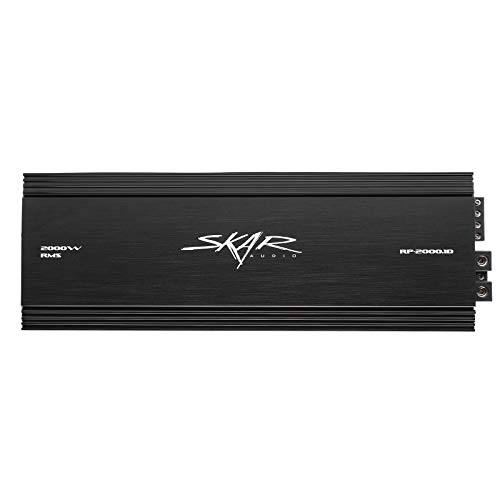
Skar Audio RP-2000.1D
Price varies, check the listingA higher-output option in the same family for buyers who want more headroom once the RMS figure is confirmed.
Check price on Amazon
Skar Audio SK-M5001D compact
Price varies, check the listingA different Skar platform worth comparing on how its listing states RMS versus max power.
Check price on AmazonFrequently asked questions
- What does the remote subwoofer level control do?
- It lets you adjust subwoofer output level from the dashboard rather than reaching to the amplifier itself, which is a day-to-day convenience feature. It is not a substitute for setting the amplifier's gain correctly at install time using a multimeter or oscilloscope against a test tone. The remote knob should sit on top of a properly set gain, not compensate for a gain that was never set.
- Is the RP-1200.1D's 1,200 watts RMS or max?
- As listed on this specific retail page, it is stated as max power, not RMS. Skar does publish RMS ratings for its amplifier lineup on its own specification sheets, so look up the current RMS figure for this exact model before sizing wire or matching a subwoofer, rather than treating the max number as equivalent to a continuous RMS rating.
- How do I size a fuse without a published RMS rating?
- Track down Skar's separate RMS specification for this model first, since fuse and wire sizing should be based on expected continuous draw, not a max power figure that carries no fixed relationship to RMS. Once you have a confirmed RMS number, run it through a current draw calculation using an assumed 80 percent class D efficiency to get a realistic amp figure to fuse against.
- What wire gauge should I run to the RP-1200.1D?
- Wire gauge should be chosen based on the amplifier's actual RMS draw and the length of the cable run, not the max power figure printed on the listing. Confirm the RMS rating separately, calculate current draw from that number, and match it against NEC ampacity figures for your chosen gauge, sizing up if the run is long enough to cause meaningful voltage drop.
- Does the RP-1200.1D need a capacitor?
- Not automatically. A capacitor only provides a brief reserve of energy for transient bass hits and does not fix a weak ground, thin wiring, a tired battery or a struggling alternator, which are the actual causes of dimming lights. A big 3 upgrade, clean grounds, a second battery and a higher output alternator are more effective first steps than a capacitor.
- Who should not buy the Skar RP-1200.1D?
- Buyers who need a firm, documented RMS number before purchase rather than a max power figure should confirm Skar's separate RMS specification for this model or consider a competing amplifier that states RMS directly on its listing. Anyone building around multiple high-power subwoofers where precise verified output matters most may prefer that clearer documentation.
Researched guidance, not professional advice. This review is based on published manufacturer specifications, the owner manual and the consensus of verified owner reviews, not a hands-on installation or bench test. Confirm the current RMS specification and pricing against the current retail listing before buying, and have any electrical work checked by a qualified installer.