Beginner

SoundBox
SoundBox PCK0 1/0 kit
$39.95A complete 1/0 kit at the lowest price here, which is the right call when the budget is going into the amplifier.
Check price on AmazonElectrical calculator
Quick answer
Voltage drop is twice the one-way run length times the current times the resistance per foot. An 87 amp draw over a 17 foot run needs 1/0 gauge to stay under 2 percent drop, and the doubling is the return path through the chassis.
Result
Ground the amplifier to bare chassis metal with the same gauge as the power wire and the shortest run you can manage. A long, thin ground undoes an expensive power wire completely.
The formula
Vdrop = 2 x run length x amps x (ohms per 1000 ft / 1000)
The 2 is the return conductor. Current leaves through the power wire and comes back through the ground path, and it drops voltage in both. Forgetting it halves the calculated drop and undersizes the cable by a full step or more, which is the most common wiring error in car audio.
The figures above are computed with these exact inputs: Amplifier RMS power 1000 W, Run length, one way 17 ft, Maximum voltage drop 2 %, Amplifier class d.
Some of these are published physics or manufacturer figures and some are conventions. They are not the same kind of number, so each one is labeled.
| Assumption | Kind | Where it comes from |
|---|---|---|
| NEC Chapter 9 | Published figure | NEC Chapter 9, Table 8, uncoated stranded copper at 75 C |
| NEC Table 310.16 | Published figure | NEC Table 310.16, 75 C copper |
| Class D Efficiency: 0.8 | Convention | A planning efficiency for a class D mobile amplifier at typical listening levels. Real efficiency varies with load impedance, output level and the amplifier itself, and no standards body publishes a single figure |
Every card below is in the page source. The calculator re-ranks them against your numbers and marks anything that falls short of what you just calculated.
A complete 1/0 kit at the lowest price here, which is the right call when the budget is going into the amplifier.
Check price on Amazon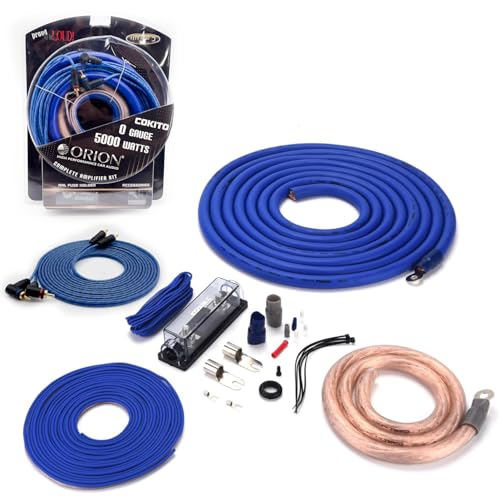
States true American Wire Gauge rather than an inflated "0 gauge" marking, which is the thing to check on a cheap kit.
Check price on Amazon
Copper clad aluminum, which is fine at this gauge for most systems and much cheaper than copper.
Check price on Amazon
Includes an ANL holder with both 250 and 300 amp fuses, so the fuse can match the wire rather than the box contents.
Check price on Amazon
True spec 0 AWG with a 17 foot run and two fuse values, which is the kit to buy when the wire itself matters.
Check price on Amazon
Sized for two amplifiers from one run, which is cheaper and tidier than two separate runs from the battery.
Check price on AmazonResearched guidance, not professional advice. These results are planning figures from published relations and manufacturer specifications. Fit the main fuse within 18 inches of the battery positive terminal, because that fuse protects the wire and the wire is what starts a fire. Disconnect the battery before running power wire, use a grommet through every piece of sheet metal, and remember that sustained high sound pressure causes permanent hearing damage.