Beginner

YukiHalu
YukiHalu 1.0 farad digital
$35.99A genuine one farad rating with a voltage readout, which is the useful part: it shows you the sag you are trying to fix.
Check price on AmazonElectrical calculator
Quick answer
One farad at 14.4 volts stores about 104 joules. A 1,000 watt amplifier draws roughly 87 amps, so a one farad capacitor holds the rail up for about six thousandths of a second per volt of allowed sag. A capacitor is a very small fix for a charging system problem.
Result
At 86.8 amps of draw, the rule of thumb capacitor holds the rail up for about 0.006 seconds. A bass note lasts longer than that, which is the whole reason a capacitor does less than people expect.
The formula
Energy E = 0.5 x C x V^2, and capacitance for a given sag C = I x t / dV
The "one farad per thousand watts" figure is a CONVENTION with no measurement behind it. The physics line is the one to trust. If your lights dim on bass notes, the honest answers in order are the big 3 upgrade, then a second battery, then a higher output alternator. A capacitor is last and it is the smallest of the four.
The figures above are computed with these exact inputs: Total system RMS power 1000 W, Voltage sag you will accept 0.5 V, Length of the bass note 0.1 s.
Some of these are published physics or manufacturer figures and some are conventions. They are not the same kind of number, so each one is labeled.
| Assumption | Kind | Where it comes from |
|---|---|---|
| Farad Per Thousand Watts: 1 | Convention | The "one farad per thousand watts" rule of thumb. It is the most repeated figure in car audio and it has no measurement behind it. One farad at 14.4 volts stores about 104 joules, which a 1,000 watt amplifier consumes in roughly a tenth of a second |
| Stored energy in a capacitor | Published figure | Stored energy in a capacitor, E = 0.5 x C x V^2, and the discharge relation C = I x t / dV |
| Class D Efficiency: 0.8 | Convention | A planning efficiency for a class D mobile amplifier at typical listening levels. Real efficiency varies with load impedance, output level and the amplifier itself, and no standards body publishes a single figure |
Every card below is in the page source. The calculator re-ranks them against your numbers and marks anything that falls short of what you just calculated.
A genuine one farad rating with a voltage readout, which is the useful part: it shows you the sag you are trying to fix.
Check price on Amazon
One farad with an audible warning for over voltage and reverse polarity, which a first install benefits from.
Check price on Amazon
A plain one farad unit from a brand that states capacitance rather than a surge figure.
Check price on Amazon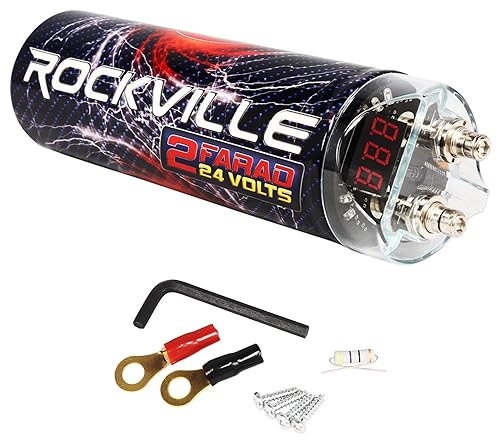
Two farads, which is roughly double the stored energy of the one farad units and still only about a fifth of a second at full draw.
Check price on Amazon
Two farads with a digital display, rated by the manufacturer for systems up to 2,000 watts.
Check price on Amazon
Sold explicitly as a true one farad with a distribution block built in, and priced like a component rather than a gadget.
Check price on AmazonResearched guidance, not professional advice. These results are planning figures from published relations and manufacturer specifications. Fit the main fuse within 18 inches of the battery positive terminal, because that fuse protects the wire and the wire is what starts a fire. Disconnect the battery before running power wire, use a grommet through every piece of sheet metal, and remember that sustained high sound pressure causes permanent hearing damage.