Beginner

Tresalto
Tresalto trim removal set, 5 piece
$7.95Nylon pry tools at under eight dollars, which is cheaper than one broken door card clip.
Check price on AmazonTuning calculator
Quick answer
Target output voltage is the square root of rated power times load impedance. A 500 watt RMS channel into 2 ohms should read 31.6 volts AC on a test tone with all processing flat, which is the number gain is set to.
Result
Set the head unit to about three quarters volume with everything flat, play the test tone, and raise the gain until the meter reads the target. Gain is an input sensitivity control and it is not a volume knob.
The formula
V = sqrt(P_rms x R)
Use a 50 or 60 Hz sine test tone for a subwoofer channel, played from the same source you actually use, with bass boost, loudness and every equalizer band flat. A true RMS meter reads a low frequency sine accurately; many cheap meters do not, and a meter that reads high will have you set the gain low, which is at least the safe direction.
The figures above are computed with these exact inputs: Rated RMS power per channel 500 W, Load impedance 2 ohms, Voltage you measured 28 V.
Some of these are published physics or manufacturer figures and some are conventions. They are not the same kind of number, so each one is labeled.
| Assumption | Kind | Where it comes from |
|---|---|---|
| Ohm's law and the series and parallel resistance relations | Published figure | Ohm's law and the series and parallel resistance relations |
| Setting amplifier gain by ear | Convention | Setting amplifier gain by ear, raising it until distortion is audible and backing off. It is folklore, it depends on hearing that is already fatigued by the time you are close, and it is why so many voice coils are burned by clipping rather than by power |
Every card below is in the page source. The calculator re-ranks them against your numbers and marks anything that falls short of what you just calculated.
Nylon pry tools at under eight dollars, which is cheaper than one broken door card clip.
Check price on Amazon
True RMS at under thirty five dollars, which is the cheapest meter that will read a test tone correctly for gain setting.
Check price on Amazon
Includes clip pliers, which are the tool that saves a door card when the clips are brittle.
Check price on Amazon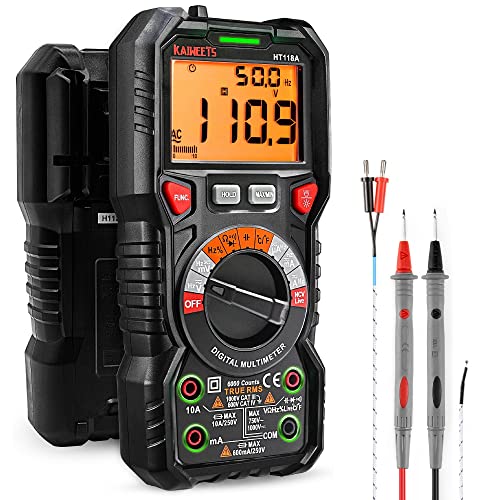
True RMS with a non contact voltage function, aimed at automotive work rather than bench work.
Check price on Amazon
Ten amp current ranges and auto-ranging, which makes measuring an actual draw practical.
Check price on Amazon
Ten dollars, and a hammer crimp on a 1/0 lug is far better than a twisted joint or a set screw.
Check price on AmazonResearched guidance, not professional advice. These results are planning figures from published relations and manufacturer specifications. Fit the main fuse within 18 inches of the battery positive terminal, because that fuse protects the wire and the wire is what starts a fire. Disconnect the battery before running power wire, use a grommet through every piece of sheet metal, and remember that sustained high sound pressure causes permanent hearing damage.