Electrical
What Size Capacitor for a 2,500 Watt System?
Researched from published physics, alignment relations and manufacturer specifications. Updated .
Quick answer
This page gives two answers, because the two answers disagree and you are entitled to know which is which.
The convention is one farad per thousand watts, so 2.5 farads for 2,500 watts. It is the most repeated figure in car audio and there is no measurement behind it.
The physics is that a capacitor stores E = 0.5 x C x V^2. At 14.4 volts, 2.5 farads holds 259.2 joules. This system draws about 217 amps, so that energy is gone in roughly 0.006 seconds. Work it through for your own numbers with the capacitor calculator.
Does a capacitor fix dimming lights on a 2,500 watt system?
Barely, and not for the reason people expect. Headlights dim because the system voltage sags when the amplifier demands more current than the charging system can supply at that instant. A capacitor can supply a large current for a very short time, which smooths a transient. A bass note is not a transient: it is tens or hundreds of milliseconds of sustained demand, which is precisely the timescale where 2.5 farads runs out.
What a capacitor genuinely does well is stabilise the rail against very fast peaks, and, in the version with a voltmeter, show you how bad the sag actually is. That diagnostic value is real and it is often the best reason to own one.
One farad per thousand watts is a convention, not a specification. It is repeated everywhere, it has no measurement behind it, and it produces a component whose stored energy is exhausted in a fraction of a second at the current the system actually draws. Treat it as a size people happen to buy rather than as an engineering answer.
What actually fixes voltage sag, in order
Four fixes, in the order they are worth doing on a 2,500 watt system.
| Fix | What it addresses | Typical outlay |
|---|---|---|
| 1. The big 3 upgrade | Resistance in the factory alternator, battery and engine ground paths | $35 to $125 |
| 2. Check and upgrade the ground | A painted or undersized amplifier ground, which is very common | Under $20 |
| 3. A second battery | Reserve capacity near the amplifier rack | $45 to $260 |
| 4. A higher output alternator | The actual supply, which is the root cause | $449 and up |
| A capacitor | Very fast transients only, plus a voltage readout | $36 to $110 |
Convention Source: Ordering reflects cost against effect rather than any published standard. The capacitor is last deliberately. Every item above it addresses a cause; a capacitor addresses a symptom, and only on a timescale shorter than a bass note.
What alternator does a 2,500 watt system actually need?
A 2,500 watt system draws about 217 amps. Added to a typical 55 amp vehicle accessory load, and with 20 percent headroom so the battery still charges, the charging system needs roughly 327 amps.
A stock alternator on a passenger car makes somewhere between 90 and 150 amps at cruising rpm and considerably less at idle. That idle figure is the one that matters, because sitting at a stoplight with the bass up is exactly when people notice the problem. Size it properly with the alternator output calculator.
If you are buying a capacitor anyway
Two things to check. First, that the capacitance is genuine: several products sold as six, ten or eighteen farads at under a hundred dollars are quoting a surge or equivalent figure rather than capacitance, and a real farad at 16 volts is a large and expensive component. Second, that it has a voltage display, because the readout is the part that tells you something useful.
Wire it in parallel with the amplifier as close to the amplifier as you can, with the same gauge as the main run, and charge it through a resistor or a light bulb before connecting: a discharged capacitor across a car battery is a dead short for the first instant.

YukiHalu 1.0 farad digital
$35.99A genuine one farad rating with a voltage readout, which is the useful part: it shows you the sag you are trying to fix.
Check price on Amazon
Belva BB1D 1.0 farad
$38.99One farad with an audible warning for over voltage and reverse polarity, which a first install benefits from.
Check price on Amazon
Recoil R1D 1 farad
$39.99A plain one farad unit from a brand that states capacitance rather than a surge figure.
Check price on AmazonCapacitors, and the things worth buying before one
YukiHalu 1.0 farad digital
$35.99A genuine one farad rating with a voltage readout, which is the useful part: it shows you the sag you are trying to fix.
Check price on Amazon Belva BB1D 1.0 farad
$38.99One farad with an audible warning for over voltage and reverse polarity, which a first install benefits from.
Check price on Amazon Recoil R1D 1 farad
$39.99A plain one farad unit from a brand that states capacitance rather than a surge figure.
Check price on Amazon
Sky High E-Series big 3, CCA
$32.95The cheapest way to do the big 3 properly, and copper clad aluminum at 1/0 still beats factory 6 gauge by a wide margin.
Check price on Amazon
True Spec oversized 1/0 OFC big 3
$82.99Oxygen free copper at a price closer to the CCA kits than most OFC options.
Check price on Amazon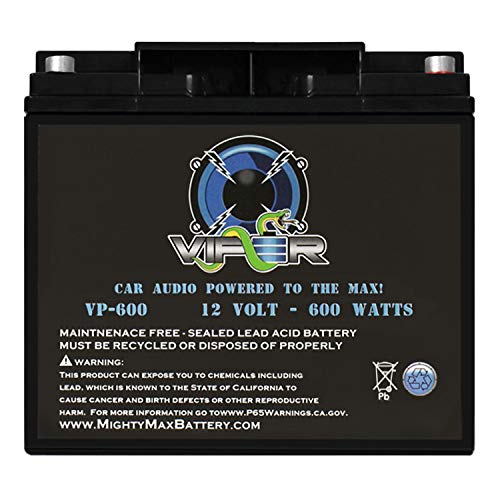
Mighty Max Viper VP-600
$44.99An 18 amp hour power cell at under fifty dollars, which is the cheapest real second battery here.
Check price on AmazonFrequently asked questions
- How many farads do I need for a 2,500 watt system?
- The convention says 2.5 farads, one per thousand watts. Understand what that buys: 259.2 joules at 14.4 volts, exhausted in about 0.006 seconds at this system's 217 amp draw. If the goal is to stop the lights dimming on bass notes, the big 3 upgrade and a proper ground will do far more for less money.
- Will a capacitor make my system louder?
- No. A capacitor stores energy that came from the alternator and the battery; it does not create any. If your rail voltage is already stable, a capacitor changes nothing measurable. If your rail is sagging badly enough that the amplifier is clipping, fixing the supply will help and a capacitor will help only for the first fraction of a second of each demand.
- Is one farad per thousand watts a real rule?
- It is a convention with no measurement behind it. It gets repeated because it is easy to remember and because it sells capacitors in round numbers. The arithmetic is unkind to it: one farad at 14.4 volts stores about 104 joules, and a thousand watt amplifier consumes that in roughly a tenth of a second. Useful as a shopping shorthand, not as engineering.
- Should I get a capacitor or a second battery?
- A second battery, in almost every case, because it stores orders of magnitude more energy for a similar price. A 20 amp hour AGM power cell holds roughly a thousand times the energy of a one farad capacitor. The catch is that the alternator now has to recharge it too, so a second battery without a charging system upgrade moves the problem rather than solving it.
- How do I wire a capacitor safely?
- In parallel with the amplifier power and ground, as close to the amplifier as possible, using the same gauge as the main run and with the existing main fuse still in place at the battery. Charge it before connecting, through a resistor or an inline bulb, because an empty capacitor across a car battery is a dead short and the arc will damage the terminal.
12V safety. A car battery will deliver several hundred amps into a short circuit without any drama at all, which is why the main fuse goes within 18 inches of the battery positive terminal. That fuse protects the wire, not the equipment: the length of cable between the battery and the fuse is unprotected, so a fuse at the amplifier end protects nothing. Disconnect the battery negative before you run power wire, and fit a rubber grommet anywhere a cable passes through sheet metal, because a bare edge will eventually cut through insulation.