Install
How Much Sound Deadening for a Midsize sedan, Doors, floor, trunk, roof and firewall?
Researched from published physics, alignment relations and manufacturer specifications. Updated .
Quick answer
Sound deadening a car is two separate jobs with two separate materials, and conflating them is why people buy the wrong amount.
Butyl constrained layer damper stops a panel ringing. It works by adding mass and shear damping to the sheet metal, and most of that benefit arrives in the first quarter of coverage. Closed cell foam is a different layer that decouples trim from metal and addresses rattles and road noise, and it goes on at full coverage.
This page sizes the butyl for the doors, floor, trunk, roof and firewall of a midsize sedan. Change the vehicle, the scope or the coverage with the sound deadening calculator.
How much material for the doors, floor, trunk, roof and firewall of a midsize sedan?
Coverage percentage is the variable that matters most for cost, and the returns fall off sharply after the first quarter.
| Coverage | Material needed | 36 sq ft packs | Estimated cost |
|---|---|---|---|
| 25 percent | 27 sq ft | 1 | $45 |
| 50 percent | 54 sq ft | 2 | $90 |
| 80 percent | 86.4 sq ft | 3 | $135 |
| 100 percent | 108 sq ft | 3 | $135 |
Convention Source: The 25 percent coverage guideline for constrained layer damper on a door skin. Manufacturers of butyl damper publish that most of the resonance reduction arrives in the first quarter of coverage, and full coverage adds mass for diminishing return. Panel areas are planning figures by vehicle class. Cost assumes $45 per 36 square foot pack, which is roughly the middle of the market. Buy one pack more than the calculation says, because offcuts around window mechanisms waste more than you expect.
Why 25 percent coverage is usually enough
A constrained layer damper works by turning the flexing of the panel into heat in the viscoelastic layer. That mechanism is most effective at the anti-nodes, which are the middle of unsupported panel spans, and it is nearly useless near a bead, a brace or a weld flange where the panel does not move anyway.
Manufacturers of butyl damper publish that most of the achievable resonance reduction arrives at roughly 25 percent coverage placed on the free spans. Going to full coverage adds mass, which does reduce panel resonance slightly further, and the return per square foot is a fraction of what the first quarter delivered. On a midsize sedan that is the difference between 27 and 108 square feet.
The 25 percent figure is a convention rather than a measurement of your car. Tap the panel with a knuckle before and after: the change from a ring to a dull thud is what you are buying, and you will hear when you have got it.
What goes on top of the butyl
Closed cell foam, at full coverage, for a completely different reason. Butyl stops the metal ringing; foam stops the trim panel buzzing against the metal and adds a barrier against road noise coming up through the floor. On a door it also lets you seal the inner skin properly so the speaker has something like an enclosure behind it.
A speaker in a door with an open inner skin cancels a large part of its own low frequency output, because the back wave meets the front wave around the edge of the cone. Sealing the inner skin is often a bigger improvement to door speaker output than replacing the speaker would have been.

AggSound closed cell foam, 36 sq ft
$29.99The cheapest closed cell foam here, and foam over butyl is where most of the road noise reduction comes from.
Check price on Amazon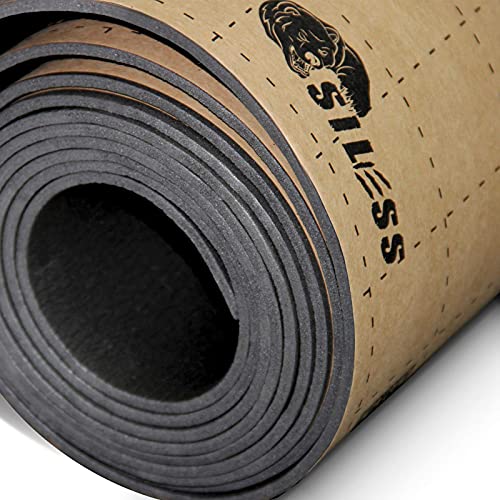
Siless Liner 4 mm, 36 sq ft
$44.95Four millimetres of closed cell PE foam, which is the standard decoupling thickness for a door card.
Check price on Amazon
Noico Red 150 mil, 36 sq ft
$49.99Self adhesive closed cell foam that also insulates against heat, which is worth having on a floor.
Check price on AmazonTools and practical notes
- Work at room temperature or warmer. Butyl will not stick properly to cold metal, and a heat gun on low makes it conform around beads.
- Roll every piece down hard with a roller. Adhesion is what makes a constrained layer work, and an unrolled sheet is just weight.
- Clean the panel with isopropyl alcohol first. Factory panels carry a film of protective oil.
- Keep the drain holes at the bottom of every door completely clear, or the door will rust from the inside.
- Stay off the window mechanism and the regulator track. Butyl in a window track is an expensive mistake.
- Wear gloves. Cut foil edges are sharp and butyl is difficult to get off skin.

Tresalto trim removal set, 5 piece
$7.95Nylon pry tools at under eight dollars, which is cheaper than one broken door card clip.
Check price on Amazon
AstroAI true RMS multimeter
$34.99True RMS at under thirty five dollars, which is the cheapest meter that will read a test tone correctly for gain setting.
Check price on AmazonButyl damper for this job

Amazon Basics deadening mat, 10 pack
$14.69The cheapest way to treat two door skins and find out whether the difference is worth more.
Check price on Amazon
80 mil butyl mat, 10 sq ft
$19.99Ten square feet is roughly what one door skin at 25 percent coverage needs.
Check price on Amazon
Zarbre 80 mil, 36 sq ft
$39.97Thirty six square feet at the lowest price per foot here, which covers four doors properly.
Check price on Amazon
CUKWUYBY 80 mil, 36 sq ft
$48.99Cut into 33 manageable sheets rather than a single roll, which makes a door far easier to work.
Check price on AmazonFrequently asked questions
- How many square feet of sound deadening for a midsize sedan?
- Treating the doors, floor, trunk, roof and firewall means about 108 square feet of panel area. At 25 percent coverage, which is where most of the benefit is, that takes roughly 27 square feet of butyl damper, or 1 standard pack. Buy one pack more than the calculation says, because offcuts around window mechanisms and seat rails waste more than people expect.
- Do I need full coverage?
- No, and paying for it is usually poor value. Most of the resonance reduction from a constrained layer damper arrives in the first quarter of coverage placed on the free spans of the panel, away from beads and braces. Full coverage adds mass and delivers a fraction of the improvement per square foot. The exception is a floor, where the extra mass genuinely helps against road noise.
- What is the difference between butyl mat and closed cell foam?
- They do different jobs and most builds want both. Butyl mat is a constrained layer damper that stops sheet metal ringing, and it goes on at about 25 percent coverage. Closed cell foam is a decoupler and barrier that stops trim buzzing against metal and reduces road noise, and it goes on at full coverage, usually on top of the butyl.
- Will sound deadening make my speakers louder?
- In a door, genuinely yes, and the reason is not damping. Sealing the inner door skin turns the door into something closer to an enclosure, which stops the back wave of the speaker cancelling the front wave around the edge of the cone. That can be a larger improvement in low frequency output than replacing the speaker would have been.
- How much weight does sound deadening add?
- Butyl damper at 80 mil weighs roughly 0.4 pounds per square foot, so 27 square feet adds about 11 pounds at 25 percent coverage. Full coverage of the same panels would be closer to 43 pounds. That is a real consideration on a small car and one more reason the 25 percent guideline is sensible.
Researched guidance, not professional advice. These are planning figures. Work on a vehicle electrical system carries real fire and injury risk: disconnect the battery before you start, keep power wire away from moving parts, steering and airbag components, and use a grommet through every panel you pass a cable through. If anything on this page is beyond what you want to take on, a professional installer is money well spent.