Subwoofers
Best Shallow Mount Subwoofers for Car Audio
Researched from published physics, alignment relations and manufacturer specifications. Updated .
Quick answer
Shallow mount subwoofers trade some mounting depth for compatibility with spaces a standard subwoofer basket simply cannot fit into: under a truck seat, inside a slim under-floor cargo compartment, or behind a factory panel with limited clearance. The tradeoff is usually a shorter magnet and motor structure, which can mean somewhat less excursion than a full-depth driver of the same diameter, so shallow subs generally ask for a bit more care in box design to get the most out of them.
This list covers two distinct paths. Bare shallow drivers, like the Pioneer and Skar options below, still need their own enclosure and a separate amp, exactly like a standard subwoofer, just in a reduced mounting depth. The Rockville SS10P is different: it is a self-powered, slim enclosure with the amp already built in, which is worth considering if simplicity of installation matters as much as depth.
Shallow mount drivers are especially common in trucks and SUVs with a false floor or a raised cargo deck, where the available vertical clearance is fixed by the vehicle's own structure rather than by how much space you are willing to give up. They also show up frequently in vehicles that already have a factory subwoofer location designed around a shallow driver, where a direct-fit shallow replacement is the only practical upgrade path without cutting into a different panel entirely.
As always, do not guess at box volume for a shallow driver. The reduced depth changes the internal volume math meaningfully, so use the exact figure from that driver's own spec sheet with our box dimensions calculator.
How we chose these subwoofers
We did not install or listen to any of these subwoofers in person. This roundup comes from manufacturer published specifications and the consensus of verified owner reviews, with particular attention paid to mounting depth, since that is the entire reason someone shops this category rather than a standard subwoofer of the same diameter. We separated bare shallow drivers, which still need their own box and amp, from the self-powered Rockville option, since treating those as interchangeable would be misleading.
We also looked for owner feedback specifically about excursion and output relative to a full-depth driver of the same size, since shallow subs are a genuine engineering compromise and it is worth knowing where that compromise shows up in real use.
How much mounting depth do you actually need?
Measure the actual clearance in your intended mounting location before shopping, not an estimate. Shallow mount subwoofers typically publish their mounting depth prominently because it is the whole point of the category, so compare that figure directly against your measured space with some margin for the enclosure walls and any port if you go ported.
If your space genuinely cannot fit any subwoofer basket at all, even a shallow one, an under-seat powered subwoofer like the ones in our best under-seat powered subwoofers guide may be a better fit, since those are built as complete pre-boxed units designed around exactly that constraint.
Specification comparison
| Subwoofer | Voice coil | Manufacturer max power | Tier |
|---|---|---|---|
| DS18 PSW10 | See listing | 500 W RMS (published) | Beginner |
| Pioneer TS-A2500LS4 | Single 4 ohm | Manufacturer-rated, see listing | Beginner |
| Skar Audio VD-10 D4 | Dual 4 ohm | Manufacturer-rated, see listing | Intermediate |
| Rockville SS10P (self-powered) | Built-in amplifier | Manufacturer-rated, see listing | Intermediate |
| Pioneer TS-A3000LS4 | Single 4 ohm | Manufacturer-rated, see listing | Expert |
| Skar Audio VS-12 D2 | Dual 2 ohm | Manufacturer-rated, see listing | Expert |
Published figure Source: Manufacturer published specifications. The Rockville SS10P is a self-powered enclosure, not a bare driver, so it does not need or accept a separate amp the way the other rows do.
Bare driver vs self-powered slim subwoofer: which shallow option fits your build
A bare shallow driver like the Pioneer or Skar options gives you full control over enclosure design, tuning, and amp pairing, exactly like a standard subwoofer, just in a reduced mounting depth. That flexibility is worth it if you already have an amp or want to fine-tune the build to your specific vehicle.
A self-powered option like the Rockville SS10P bundles the driver, enclosure, and amp into one slim unit, which trades some of that customization for a dramatically simpler installation. It is a reasonable choice if you want a meaningful bass upgrade without wiring a separate amp, running new RCA cables, or building a custom box.
There is a middle path worth mentioning too: some owners buy a bare shallow driver specifically because a matching pre-built shallow enclosure is available for their exact vehicle, which removes the box-building step while still keeping a separate, upgradable amp in the signal path. That combination can be worth pricing out before defaulting straight to a fully self-powered unit.
Buying tips
- Measure your actual available mounting depth with a tape measure before comparing spec sheets, since manufacturer depth claims are precise and worth taking seriously.
- Decide upfront whether you want a bare driver you box and amp yourself, or a self-powered slim unit that handles both for you.
- Expect somewhat less excursion from a shallow driver than a full-depth driver of the same diameter, and factor that into your output expectations.
- Use the exact published box volume for the specific shallow driver you buy, since shallow designs often have different Thiele-Small parameters than a standard driver of the same size.
- If going with a self-powered unit, confirm it includes the wiring kit you need or budget for one separately.
Wiring and power safety
Disconnect the battery before running power wire, even for a compact shallow mount installation. Mount the main fuse within 18 inches of the battery positive terminal, since it protects the wire from a short circuit rather than the amp or subwoofer, and route wire through a grommet anywhere it passes through sheet metal. Sustained high SPL causes permanent hearing damage regardless of how compact the subwoofer producing it is.
The picks, by tier

DS18 PSW10.4D shallow 10
$179.95Publishes a 500 watt RMS rating, a genuine documented number that is unusually specific for the shallow mount category, in a slim self-contained design.
Check price on Amazon
Pioneer TS-A2500LS4 shallow 10
$117.95A widely stocked, widely reviewed 10 inch shallow driver that is a safe, simple starting point for a first low-clearance build.
Check price on Amazon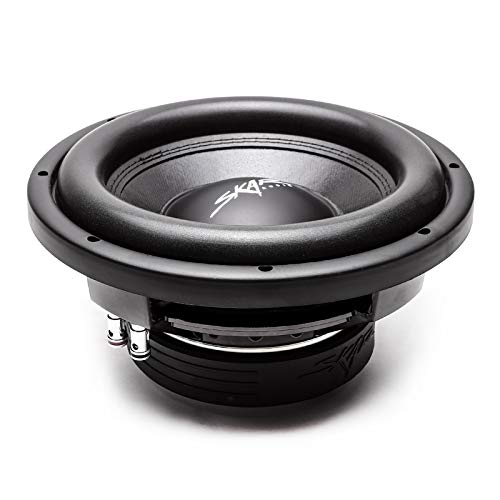
Skar Audio VD-10 D4 shallow
Price varies, check the listingA dual 4 ohm shallow 10 inch driver built to handle more power than most entry-level shallow subs in the same mounting depth.
Check price on Amazon
Rockville SS10P slim
$139.95A self-powered slim 10 inch subwoofer that skips the separate amp entirely, which simplifies installation in a tight space considerably.
Check price on Amazon
Pioneer TS-A3000LS4 shallow 12
$154.83A 12 inch cone in a shallow basket gives more air movement than a shallow 10 while keeping the reduced mounting depth intact.
Check price on Amazon
Skar Audio VS-12 D2 shallow
Price varies, check the listingA dual 2 ohm shallow 12 inch driver for experienced builders wiring toward a lower final impedance for more output.
Check price on AmazonFrequently asked questions
- Do shallow mount subwoofers sound worse than standard subwoofers?
- Not necessarily worse, but they generally trade some excursion capability for reduced mounting depth, which can mean somewhat less maximum output at equal power compared to a full-depth driver of the same diameter. Many owners find a well matched shallow driver in a correctly sized box still delivers satisfying bass for daily-driven use.
- What is the difference between a shallow mount subwoofer and a powered subwoofer?
- A shallow mount subwoofer is a bare driver with a reduced mounting depth that still needs its own enclosure and separate amplifier, just like a standard subwoofer. A powered subwoofer includes the amplifier built into a self-contained enclosure, so it needs only power and signal wiring, not a separate amp.
- Can I use a shallow mount subwoofer with a standard enclosure?
- You can, but you would lose the depth advantage that makes a shallow driver worth choosing in the first place, so it only makes sense if you specifically want the driver's other characteristics rather than its reduced depth. Most buyers choose shallow drivers specifically to fit a tight space with a matching low-profile box.
- Is a 10 inch or 12 inch shallow mount subwoofer better?
- A shallow 12 inch driver generally moves more air than a shallow 10 at similar power, assuming both fit your available depth, since the larger cone surface area is the main advantage in this comparison. Choose based on which diameter actually fits your mounting location and measured clearance, then pick the largest one that does.
- Does a self-powered slim subwoofer need a separate fuse?
- Yes. A self-powered subwoofer still draws significant current from the vehicle's electrical system and needs its own properly sized inline fuse mounted within 18 inches of the battery positive terminal, exactly like a separate amp would, even though the amplifier itself is built directly into the enclosure rather than sold as its own separate component.
Researched guidance, not professional advice. Disconnect the battery before running power wire, keep the main fuse within 18 inches of the battery positive terminal, and use a grommet anywhere wire passes through sheet metal. A fuse protects the wire, not your equipment, and sustained high SPL causes permanent hearing damage even from a compact shallow mount setup.