Subwoofers
Shallow Mount vs Standard Subwoofer: Which Depth Do You Need?
Researched from published physics, alignment relations and manufacturer specifications. Updated .
Quick answer
Shallow mount subwoofers exist to solve one specific problem: not enough mounting depth. A standard-depth driver's motor structure, the magnet and voice coil assembly behind the cone, needs a certain amount of physical space behind the mounting flange, and in a truck under-seat enclosure, a tight custom console, or any install where depth is the hard limit, a standard driver simply will not fit no matter how well the rest of the box is designed. A shallow mount driver shortens that motor structure to fit the available depth, and that shortening comes with real, physics-based tradeoffs rather than being a free alternative.
This comparison lays out what changes when a driver's motor gets shorter, where shallow mount is genuinely the better tool for the job, and where reaching for one when a standard driver would actually fit leaves output on the table for no reason.
What does a subwoofer actually give up to go shallow?
Primarily Xmax, the maximum linear distance the cone can travel in either direction before distortion rises sharply, and often sensitivity as well. A shorter motor structure generally means a shorter voice coil winding and less linear travel available to the cone, and Xmax is directly tied to how much air a driver can move at low frequencies where excursion, not surface area alone, becomes the limiting factor. A shallow mount driver at the same nominal size as a standard driver commonly has less Xmax and, in many designs, somewhat lower efficiency for the same cone area, simply because the shortened motor generates less driving force per watt than a deeper, larger motor structure would.
None of this makes a shallow mount driver a lesser product. It is an engineering tradeoff made deliberately to solve a packaging problem, and for the install it is designed for, giving up some Xmax and efficiency in exchange for fitting a space a standard driver cannot reach is exactly the right trade.
Head to head
| Characteristic | Shallow Mount | Standard Depth |
|---|---|---|
| Mounting depth | Reduced, fits tight spaces | Standard, needs more clearance |
| Xmax | Generally lower | Generally higher |
| Efficiency at equal cone area | Generally lower | Generally higher |
| Typical box volume | Often smaller | Often larger |
| Best use case | Depth-constrained installs | Installs with room to spare |
Convention Source: General tradeoffs of shallow mount versus standard-depth driver design; exact figures vary by specific model.. The exact Xmax, sensitivity, and recommended box volume for any driver come from its own manufacturer spec sheet.
Depth is the only reason to choose shallow
If a standard-depth driver physically fits the available mounting space, it generally has an efficiency and Xmax advantage worth taking. Shallow mount drivers solve a real packaging constraint, but choosing one when depth is not actually the binding limit trades away output potential for no benefit. Measure the actual available mounting depth in the vehicle before assuming a shallow mount driver is needed.
Where shallow mount is the right answer
Under a truck or SUV rear seat, inside a factory subwoofer location with limited depth behind the trim panel, or in a low-profile enclosure built into a false floor are the classic cases where shallow mount earns its place: the available depth is fixed by the vehicle or the install location, and no amount of box design changes that number. In these installs, a shallow mount driver's reduced Xmax and efficiency are simply the cost of fitting a space nothing else could, and shallow mount enclosures are commonly sized smaller as well, which suits these tight, low-profile locations on both dimensions at once.
Where a standard driver is still the better fit
In a conventional trunk build, a cargo area box, or any install where there is meaningful depth to work with, a standard-depth driver generally offers more Xmax and better efficiency for the same cone area, which translates into more output potential from the same size driver. Reaching for a shallow mount option in this situation trades away that advantage without any packaging benefit, since the depth constraint that justifies a shallow driver simply is not present.
Checking the box volume either way
Shallow mount drivers often carry their own, sometimes smaller, recommended net volume compared to a standard-depth driver of the same nominal size, a consequence of the different motor and suspension design rather than a rule that applies to every shallow driver equally. That recommended volume is published on the specific driver's spec sheet and should be run through the sealed box volume calculator or ported box volume calculator directly, rather than assumed to be a fixed fraction of what a standard driver of the same size would need.
Who should buy which

Pioneer TS-A2500LS4 shallow 10
$117.95A 10 inch shallow mount driver suited to a depth-constrained install such as a truck under-seat enclosure where standard mounting depth will not fit.
Check price on Amazon
Skar Audio VS-12 D2 shallow
Price varies, check the listingA 12 inch shallow mount driver for tighter cargo areas or factory locations where a standard 12 inch motor structure would not clear the available depth.
Check price on Amazon
CT Sounds Bio 10 D2
$69.99A standard-depth 10 inch driver for installs with enough mounting depth, where the added Xmax and efficiency over a shallow mount option are worth taking.
Check price on Amazon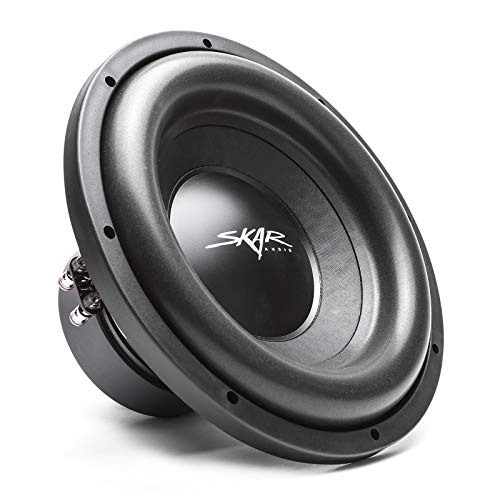
Skar Audio SDR-12 D4
Price varies, check the listingA standard-depth 12 inch driver for a conventional trunk or cargo box build with no depth constraint forcing a shallow mount choice.
Check price on AmazonFrequently asked questions
- Does a shallow mount subwoofer sound worse than a standard one?
- Not inherently worse, but it generally trades away some Xmax and efficiency for the same cone area because of its shortened motor structure. In a properly sized box matched to its own spec sheet, a shallow mount driver can still sound tight and accurate. The tradeoff shows up mainly as somewhat less output headroom compared to an equivalent standard-depth driver.
- How do I know if I need a shallow mount subwoofer?
- Measure the actual available mounting depth in the install location, whether that is under a seat, inside a factory subwoofer well, or behind a low-profile panel. If a standard-depth driver's motor structure will not clear that measured depth, a shallow mount driver is the right choice. If there is room to spare, a standard driver generally offers more output potential.
- Do shallow mount subwoofers need a smaller box than standard ones?
- Often, yes, since many shallow mount drivers carry a smaller recommended net volume as part of their overall design, but this varies by specific model and is not a fixed rule. Always check the exact driver's own manufacturer spec sheet for its recommended sealed or ported volume rather than assuming a percentage reduction from a standard driver.
- Can I use a shallow mount subwoofer in a regular trunk build?
- Yes, there is no rule against it, but doing so trades away Xmax and efficiency for no packaging benefit if a standard-depth driver would have fit the same trunk space. A shallow mount driver makes the most sense when depth is genuinely the limiting factor, not as a default choice for a build with room to spare.
- Is Xmax the main difference between shallow and standard subwoofers?
- Xmax is usually the most significant difference, since a shorter motor structure generally limits how far the cone can travel linearly before distortion rises. Efficiency for a given cone area is also commonly lower on shallow mount designs. Both differences stem from the same shortened motor and suspension geometry that makes the reduced mounting depth possible.
- Are shallow mount subwoofers more expensive than standard ones?
- Pricing varies by brand and model rather than by mounting depth alone, and shallow mount options are not automatically pricier than standard-depth drivers of the same nominal size. The decision between the two should be based on the available mounting depth and the output tradeoff, not on an assumption about which category costs more.
Researched guidance, not professional advice. Measure the vehicle's actual available mounting depth before choosing between shallow mount and standard-depth drivers, and confirm Xmax, sensitivity and recommended box volume on the exact model's manufacturer spec sheet.