Install
AudioControl LC2i Review: AccuBASS and Active Line Output
Researched from published physics, alignment relations and manufacturer specifications. Updated .
Quick answer
The AudioControl LC2i is a two channel line output converter, the small box that takes speaker level output from a factory head unit and converts it into a line level RCA signal an aftermarket amplifier can use. What sets it apart from a basic converter is AccuBASS, a circuit that automatically restores low frequency content that most factory head units quietly roll off as volume increases, a behavior built into factory systems to protect small factory speakers from overexcursion.
This review is compiled from the manufacturer published specifications, the owner manual and the consensus of verified owner reviews. We have not installed, measured or listened to this unit ourselves. Where a specific output voltage range or dimension is not part of the published data we relied on, we say so rather than filling in a number that was not provided.
What are the published specifications?
| Specification | Value |
|---|---|
| Channels | 2 |
| Converter type | Active (has its own line driver circuit) |
| Signature feature | AccuBASS, automatic bass restoration |
| Function | Converts factory speaker-level output to line-level RCA output for an aftermarket amplifier |
| Exact output voltage range | Not part of the published figures used for this review; confirm on the current listing |
Published figure Source: Manufacturer published specifications. AccuBASS is described by the manufacturer as automatically restoring low frequency content that a factory head unit reduces as volume rises, rather than as a manually adjustable bass boost the installer sets once and leaves.
What does factory bass rolloff actually mean?
Many factory head units quietly reduce low frequency output as overall volume climbs, a design choice meant to protect small factory door speakers from being overdriven at high volume. That rolloff is invisible on the dash; the volume knob still goes up, but the bass content in the signal itself is being reduced by the head unit before it ever reaches a speaker or, in an upgraded system, before it reaches a line output converter feeding an amplifier and subwoofer.
The practical result is a system that sounds thin or bass-light at higher volumes even after installing a capable amplifier and subwoofer, because the source signal feeding that amplifier has already lost the low end the factory unit decided to cut. This is a common and often misdiagnosed problem in factory-radio-retained upgrades, and it is the specific problem AccuBASS is designed to address.
What is the difference between a passive and an active line output converter?
A passive line output converter is essentially a resistor network that divides the factory head unit's speaker-level voltage down to a line-level signal an amplifier can accept. It has no power supply of its own and cannot add anything back into the signal; it can only reduce what is already there. If the factory head unit has already rolled off bass at higher volume, a passive converter passes that reduced signal through unchanged.
An active line output converter, which is what the LC2i is, has its own line driver circuit and its own power connection, which lets it do more than simply divide voltage. In the LC2i's case, that active circuitry is what makes AccuBASS possible: it can detect the volume-dependent bass reduction happening at the factory head unit and boost the low frequency content back into the signal it hands off to the amplifier, rather than just passing along whatever level the head unit provides.
AccuBASS works automatically, not as a manual boost
AccuBASS is automatic, not a set-and-forget knob you dial in once for effect. The manufacturer describes it as restoring low frequency content as the factory head unit's volume increases, tracking that rolloff dynamically rather than applying a fixed boost at all volume levels. That is different from a manual bass boost dial on a basic amplifier, which raises bass by a fixed amount regardless of what the source signal is doing.
Do I still need a line output converter if my head unit has RCA outputs?
If your existing head unit already has dedicated preamp RCA outputs, a line output converter is generally unnecessary, since those RCA outputs are already line level and were not shaped by the speaker-level circuitry a converter is designed to interface with. A converter like the LC2i earns its place specifically in factory-radio-retained installs, where the only available signal is the speaker-level output built for factory door speakers, not a dedicated preamp output.
If you are unsure whether your factory head unit's rolloff behavior is actually hurting your system's bass response, that is a diagnosis worth making before buying a converter, since AccuBASS solves a real but specific problem and is not a general-purpose upgrade for every install. This is also the point where a wiring diagram for your exact factory head unit matters, since tapping into the wrong pair of speaker wires can feed a converter an unbalanced or noisy signal regardless of how good the converter itself is.
Who should not buy the LC2i?
Anyone whose head unit already provides dedicated preamp RCA outputs does not need a line output converter at all, active or passive, and should skip this purchase. Anyone needing more than two channels of converted output, for a multi-amp system driving front, rear and subwoofer channels separately from one factory source, will need a larger converter than this two channel unit. Anyone expecting a simple passive-style resistor box for the lowest possible cost, without needing AccuBASS's active bass restoration, may be better served by a cheaper passive converter instead.
Anyone who has not actually confirmed that their factory head unit rolls off bass at higher volume should also hold off, since AccuBASS solves a specific, diagnosable problem rather than being a general-purpose upgrade every factory-radio-retained install automatically needs. Listening for a thin, bass-light character specifically at higher volume, not at low volume, is the practical way to confirm the problem this converter is built to fix.
What else to consider
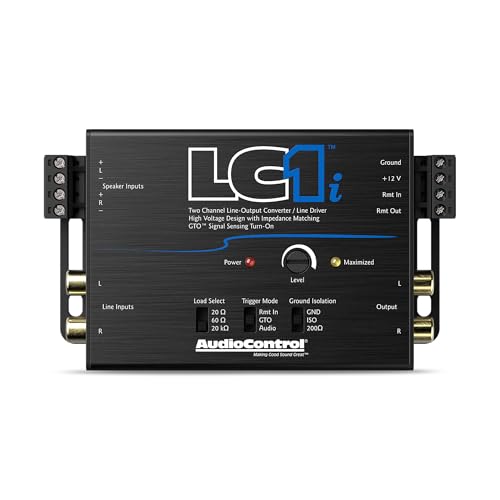
AudioControl LC1i
$65.00A single channel version of the same active AccuBASS platform for a subwoofer-only conversion.
Check price on Amazon
Scosche LOC80
$9.99A budget line output converter to compare against an active unit when AccuBASS-style bass restoration is not needed.
Check price on Amazon
CT Sounds CT-LC2 with BassLift
$49.99Another two channel converter worth comparing on price and feature set before deciding.
Check price on AmazonFrequently asked questions
- What does AccuBASS actually do?
- AccuBASS is a circuit built into the LC2i that automatically restores low frequency content that many factory head units reduce as volume rises. Factory units often roll off bass at higher volume to protect small factory speakers, which can make an upgraded system sound thin. AccuBASS tracks that rolloff and boosts the low end back into the signal it sends to the amplifier.
- Why does my system sound thin at higher volume without this?
- Many factory head units quietly reduce bass output as volume increases, a design choice meant to protect small factory door speakers from overexcursion. That reduced signal then feeds any downstream amplifier and subwoofer, so the system sounds progressively thinner at higher volumes even though the amplifier and subwoofer themselves are capable of more bass.
- What is the difference between active and passive line output converters?
- A passive converter is a resistor network that only divides the factory speaker-level signal down to line level; it cannot add anything back in. An active converter like the LC2i has its own line driver circuit and power connection, which lets it boost or shape the signal, making features like AccuBASS's automatic bass restoration possible in a way a passive unit cannot do.
- How many channels does the LC2i have?
- It is a two channel unit, meaning it converts two channels of factory speaker-level signal into two channels of line-level RCA output. A system needing separate converted channels for front, rear and subwoofer amplifiers from one factory source would need a larger converter or multiple LC2i units rather than a single two channel unit.
- Do I need a line output converter if my head unit has RCA outputs?
- Generally no. Dedicated preamp RCA outputs on a head unit are already line level and were not shaped by the speaker-level circuitry a converter is built to interface with. A converter like the LC2i is meant for factory-radio-retained installs where speaker-level output is the only signal available, not for head units that already provide RCA preamp outputs.
- Who should not buy the AudioControl LC2i?
- Anyone whose head unit already has dedicated RCA preamp outputs does not need a converter at all. Anyone needing more than two converted channels for a multi-amp system will need a larger unit. Anyone who does not need AccuBASS's active bass restoration and wants the lowest possible cost may be better served by a simpler passive converter instead.
Researched guidance, not professional advice. This review is based on published manufacturer specifications, the owner manual and the consensus of verified owner reviews, not a hands-on installation or listening test. Confirm exact output specifications against the current listing before buying, and have any wiring work checked by a qualified installer.