Expert build
A Sound Quality Front Stage with DSP
Researched from published relations and manufacturer specifications. Updated .
Quick answer
Sound quality in a car is decided by time alignment and door treatment, not by speaker price. A DSP that delays the near-side speakers so both arrive together does more for imaging than any speaker upgrade, because the fundamental problem in a car is that you are sitting much closer to one side than the other.
This build has a different goal from every other one on this site. It is not trying to be loud. It is trying to put a stereo image on the dashboard in a vehicle where you sit two feet from one speaker and five feet from the other.
That asymmetry is the whole problem, and no speaker solves it. A processor that delays the near-side channels so both arrive at your ears together is what solves it, which is why the DSP here matters more than the drivers do. Say plainly what this costs: it is a harder, more expensive build than the others, and a first system is better served by the full system rebuild.
The complete parts list
Grouped by function rather than by price, so you can see what each part of the system costs on its own. Every line links to the product, and the total is computed from catalog prices rather than typed by hand.
Source
$149.00-
 Kenwood
Kenwood KMM-BT332U
Three preout pairs and a detachable face. A real source unit rather than a converted factory signal.
Processing
$199.98-
 Dayton Audio
Dayton Audio DSP-408
Four in, eight out, with time alignment, crossovers and input mixing. This is the component that makes the build.
Front stage
$171.90-
-
 PIONEER
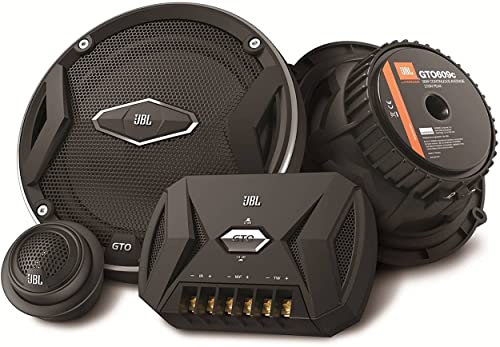
Pioneer TS-A301TW
A spare tweeter pair for a pillar build, matched to a known crossover point.
Treatment, which is not optional here
$144.94-

-
 Siless
Siless LinerPRO 5 mm, 36 sq ft
Five millimetre closed cell foam, as thick as most door cards will clear.
Amplification
$321.37-
 AudioControl
AudioControl EpicFive
AudioControl publishes real specifications and supports its products for years, which is what the price buys.
-
 Elite Audio
Elite Audio premium 17 ft
Double shielded oxygen free copper, for a system where the noise floor is now audible.
-
 SINUS LIVE
Sinus Live 16 to 18 AWG OFC, 50 ft
Oxygen free copper speaker wire for the long run to the rear deck.
Bass that stays out of the way
$149.87-
 KICKER
Kicker Comp 10
A 10 rather than a 12. This build wants the subwoofer to disappear, not to announce itself.
-
 BELVA
BELVABelva MDFS10, 0.77 cu ft
A stated 0.77 cubic feet sealed. Check it against what your driver publishes.
Tools
$177.72-
 Fluke
FlukeFluke 17B+ multimeter
A Fluke will still be accurate in ten years. Nothing else here can make that claim.
-
 TOPTES
TopTes TS-501B sound level meter
A 30 to 130 dB A and C weighted meter, for knowing what the system actually does.
-

Build total
$1314.7814 lines across 7 groups. Prices change often and are a guide only.
What you can skip
Telling you not to buy something is what makes the rest of this list worth reading. On this build, these are the things people add that are not earning their place.
- A second subwoofer. Bass output is not the goal and more of it makes the front stage harder to place.
- A capacitor. A sound quality build draws modest current and a clean electrical system matters more than a stiffening component.
- Rear speakers entirely. Many sound quality builds run front stage and subwoofer only, because rear fill pulls the image backwards.
What to upgrade first
When the budget comes back around, this is the order that gets the most for the money.
- An active three way front stage, once you are comfortable with the processor. Separate midbass, midrange and tweeter channels remove the passive crossover from the path.
- A measurement microphone, because tuning by ear in a car is guesswork at this level.
- More door treatment. It is the cheapest remaining improvement on almost every build.
Frequently asked questions
- What does a DSP actually do that a head unit cannot?
- Time alignment, primarily. It delays the channels closest to you by a few milliseconds each so the sound from both sides arrives at your ears together, which is what creates a centred stereo image in a car. It also gives independent crossovers and equalization per channel, so each driver can be filtered for its own capability rather than for the pair.
- Is an expensive speaker worth it in a car?
- Less than you would think, and much less than treatment and processing. A car interior is a small, reflective, asymmetric space with a speaker mounted at ankle height in a flexing steel panel. Fixing the panel and fixing the arrival times addresses the actual problems. An expensive driver in an untreated door mostly reveals how bad the door is.
- Do I need to give up the factory head unit for this?
- Not strictly, because a good line output converter and a DSP can take a factory signal. In practice a real head unit with clean preouts removes a stage of conversion and gives you a higher, less compressed signal to work with. If your factory system is integrated with screens and chimes, keeping it and converting is the pragmatic choice.
- Should I run the front stage active?
- Eventually, yes, and not on day one. Running active means the DSP handles the crossover for each driver directly and the passive crossover comes out of the path, which gives much finer control. It also means a mistake sends full range signal to a tweeter, which destroys it instantly. Learn the processor passively first.
Researched guidance, not professional advice. A car battery will deliver several hundred amps into a short without any drama at all. Fit the main fuse within 18 inches of the battery positive terminal, because that fuse protects the wire and the wire is what starts a fire. Disconnect the battery negative before running power wire, fit a grommet anywhere a cable passes through sheet metal, and keep cables away from steering, airbag and moving components. Sustained high sound pressure causes permanent hearing damage.
Build list
Get the parts list as a checklist
One email with the full build list, every part linked. Nothing else.
No spam. Unsubscribe whenever you like.