Tuning
How to Tune a Subwoofer Crossover and Phase
Researched from published physics, alignment relations and manufacturer specifications. Updated .
Quick answer
Once an amplifier's gain has been set correctly with a multimeter, the remaining controls, the low pass crossover, the subsonic filter, and the phase switch, shape how the subwoofer blends with the rest of the system rather than how loud or clean it plays. These controls interact with each other and with the box the subwoofer is mounted in, so setting them in the wrong order or skipping one can undo the careful work that went into setting gain in the first place.
This guide covers where to start each control, why the subsonic filter setting depends on the box type, and why phase in a car has to be judged at the listening position rather than assumed from a diagram.
What does the crossover on a subwoofer amp actually do?
The low pass crossover on a subwoofer amplifier blocks frequencies above a chosen cutoff from reaching the subwoofer, so the sub only reproduces bass and is not asked to play midrange content it was not designed for. A matching high pass crossover on the front door speakers blocks frequencies below their own cutoff, so the doors are not asked to reproduce the deep bass that will overwhelm a smaller speaker and increase distortion. Setting these two crossovers to meet near each other, rather than leaving a gap or a heavy overlap, is what makes the transition between the subwoofer and the door speakers sound seamless instead of having an obvious hole or a doubled-up hump in the midbass.
Starting points for crossover and subsonic filter settings
| Filter | Typical Starting Point | Purpose |
|---|---|---|
| Subwoofer low pass | 70 to 100 Hz | Keeps midrange out of the subwoofer |
| Door speaker high pass | Matched to sub's low pass | Keeps deep bass out of the doors |
| Subsonic filter (ported box) | Just below port tuning frequency | Protects driver from unloading below tuning |
Convention Source: Common car audio tuning starting points; final values depend on the specific speakers and box.
Setting the subsonic filter on a ported box
A ported box reinforces the driver's output right around its tuning frequency, but below that tuning frequency, the port stops helping and the driver effectively unloads, meaning it sees much less acoustic resistance from the box than it does at or above tuning. With less resistance to work against, excursion rises sharply for the same input signal, and a subwoofer can be driven well past its linear range on frequencies the box was never designed to reinforce, even at a gain setting that is otherwise correct. A subsonic filter set just below the box's tuning frequency rolls off that content before it reaches the driver, protecting it from this specific failure mode. A sealed box does not have this same sharp unloading behavior, so a subsonic filter is less critical there, though a high pass well below the box's response can still be useful protection against extreme low frequency content like wind noise or vehicle door slams.
Bass boost and clipping
Bass boost is a fixed equalizer boost at a specific frequency, and it is one of the fastest ways to clip an amplifier that has otherwise had its gain set correctly. Gain set with a multimeter assumes the source signal reaches the amplifier at its normal level; engaging bass boost adds extra level on top of that at the boosted frequency, which can push the amplifier into clipping on bass-heavy content even though the gain itself was never touched. If more low-end impact is wanted, it needs to come from the box design, the subwoofer choice, or careful EQ rather than a fixed boost stacked on top of a gain setting that assumed it would not be there.
Setting phase and the 0/180 switch
Phase, whether a continuously variable control or a simple 0/180 switch, adjusts the timing relationship between the subwoofer's output and the front speakers' output. In a home stereo with symmetric speaker placement, phase can sometimes be reasoned out from the wiring diagram, but in a car, the subwoofer is usually mounted behind the listener in a trunk or cargo area while the front speakers are in the doors beside the listener, so the physical distances and reflections are asymmetric in a way a diagram cannot predict. The practical method is to play bass-heavy material at a normal listening level, switch phase between the two positions, and choose whichever position produces louder, more cohesive bass at the driver's seat, since that is a direct measure of the two sources adding together constructively rather than partially canceling.
Order of operations: gain, then crossover, then phase
Setting gain first with a multimeter establishes the amplifier's maximum clean output independent of any tone shaping. Setting the crossover and subsonic filter next shapes what content actually reaches the driver, which is unrelated to the voltage-based gain setting and should not be changed to compensate for a perceived loudness issue that is really a crossover or box issue. Setting phase last makes sense because it is a subjective, by-ear adjustment that should be judged against the final tonal balance the crossovers have already established, not against a system that is still missing part of its frequency range.
What you need

Dayton Audio DSP-408
$199.98A time alignment and crossover DSP for finer control over crossover slopes and subwoofer-to-door timing than a basic amplifier crossover provides.
Check price on Amazon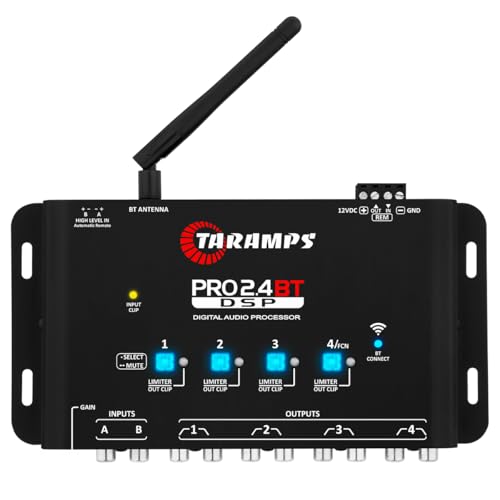
Taramps Pro 2.4 BT
$59.00A 15 band Bluetooth-enabled DSP for adjusting crossover points and basic EQ from a phone without needing a laptop connection.
Check price on Amazon
TopTes TS-501B sound level meter
$29.99An SPL meter with A and C weighting for comparing output level between phase settings or crossover points during tuning.
Check price on AmazonFrequently asked questions
- What frequency should I set my subwoofer's low pass crossover to?
- A starting point between 70 and 100 Hz is common, with the front door speakers' high pass set to roughly match. The exact best value depends on how well the door speakers reproduce the low end and personal preference for how much midbass overlap sounds natural, so treat 70 to 100 Hz as a starting range to fine-tune from, not a fixed answer.
- Do I need a subsonic filter on a sealed subwoofer box?
- It is less critical than on a ported box, since a sealed box does not have the same sharp driver unloading below a tuning frequency. A subsonic filter can still offer some protection against extreme low frequency content, but the main reason to prioritize one is specifically for ported enclosures, where output below tuning drops off and excursion can rise quickly.
- How do I know if my subwoofer's phase is set correctly?
- Play bass-heavy content at a normal listening level, switch the phase control or 0/180 switch between positions, and pick whichever position sounds louder and more cohesive at the driver's seat. There is no universal correct switch position because it depends on the specific distances between the subwoofer and front speakers in that vehicle.
- Should bass boost ever be used on a subwoofer amplifier?
- It should be used cautiously, if at all, since it adds a fixed boost at a specific frequency on top of a gain setting that assumed no extra boost was present. If more low-end presence is wanted, adjusting the box design, subwoofer choice, or a general EQ curve is safer than a large fixed bass boost that risks clipping the amplifier on bass-heavy music.
- What order should gain, crossover, and phase be set in?
- Set gain first with a multimeter to establish the amplifier's clean power ceiling, then set the crossover and subsonic filter to shape what content reaches the driver, then set phase last by ear once the tonal balance from the crossovers is already in place. Changing this order risks compensating for one problem by mis-adjusting an unrelated control.
- Can a DSP replace the crossover built into my amplifier?
- Yes, a DSP placed ahead of the amplifier can provide its own crossover, often with steeper slopes and added time alignment, and in that setup the amplifier's own crossover is typically left wide open or bypassed so it does not double up with the DSP's filter. This gives finer control than most built-in amplifier crossovers alone.
Researched guidance, not professional advice. Always set gain with a multimeter before adjusting crossover, subsonic filter, or phase, and treat bass boost as an occasional option rather than a default setting.